The DBS 3Q 2026 financial results were released on 5 November 2026, and they tell a story of a bank whose core business keeps growing even as a weak quarter for trading pulled headline profit lower. Net profit for the third quarter came in at S$2.81 billion, down 5% from a year ago and 9% from the second quarter. Yet for the first nine months of 2026, DBS still delivered a record net profit of S$8.82 billion, and shareholders will receive a total dividend of 81 cents per share for the quarter.
In this post, I will walk through the key numbers, explain what drove the dip in quarterly earnings, look at the health of the balance sheet, and share what the dividend means for me as a shareholder. As always, I write this from the perspective of a retail investor who holds DBS for income over the long term, not as a trader looking for short-term price moves.
DBS 3Q 2026 Financial Results at a Glance
Here are the headline figures from the DBS 3Q 2026 financial results, comparing the third quarter of 2026 with the same quarter in 2025.
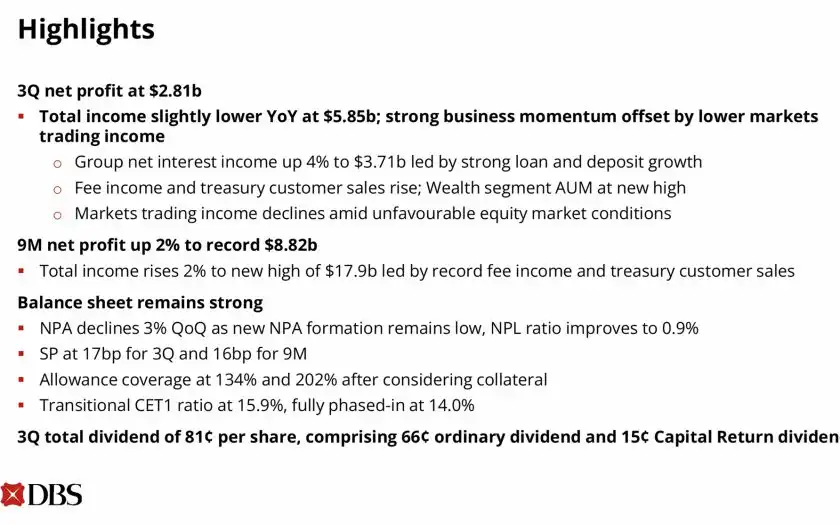
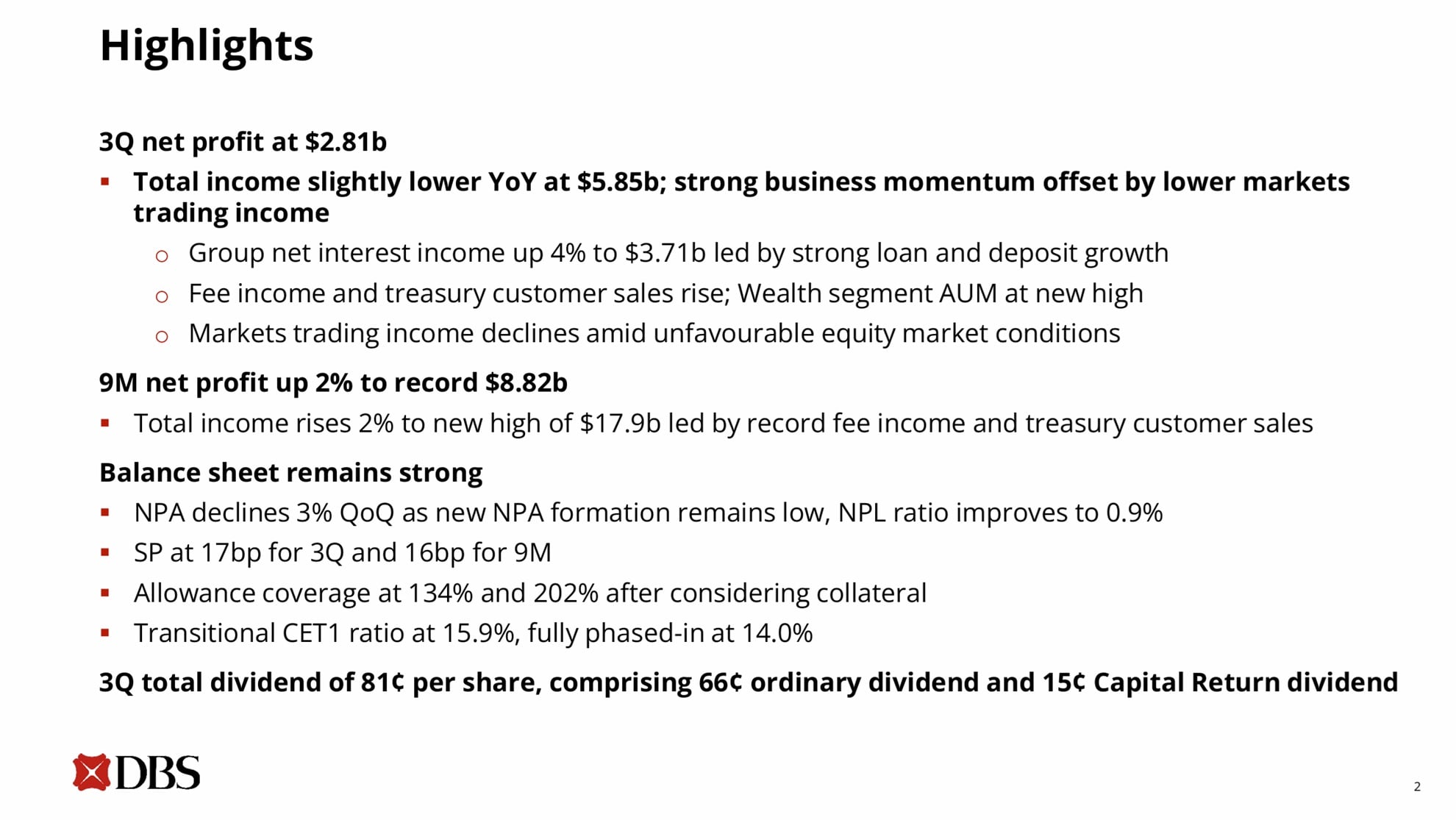
Total income slipped 1% to S$5.85 billion. Net interest income rose 4% to S$3.71 billion. Net fee and commission income increased 6% to S$1.43 billion. Treasury customer sales and other income jumped 19% to S$685 million. Markets trading income, however, plunged 65% to just S$152 million. Expenses fell 1% to S$2.37 billion, and the cost-to-income ratio was about 41%. Net profit declined 5% to S$2.81 billion.
The return on equity for the quarter was 16.0%, lower than the 17.1% recorded a year earlier and the 17.9% achieved in the second quarter of 2026. Annualised earnings per share came to S$3.93, compared with S$4.12 a year ago. Net book value per share stood at S$24.47.
On a nine-month basis, the picture looks much healthier. Total income rose 2% to a record S$17.9 billion, net profit grew 2% to a record S$8.82 billion, and return on equity held steady at 17.0%. The cost-to-income ratio for the nine months was stable at around 39%.
Why Did Quarterly Profit Fall?
The single biggest reason for the drop in third quarter profit was markets trading income. This is the money DBS makes from its own trading activities in financial markets, as opposed to the income it earns from serving customers. Management attributed the weakness to unfavourable conditions in equity markets during the quarter.
To put the size of the decline in context, markets trading income fell by roughly S$287 million compared with a year ago and by about S$317 million compared with the second quarter. That alone was larger than the entire drop in net profit. In other words, if trading income had stayed at its usual level, net profit would likely have been higher than a year ago.
The other drag on earnings was a rise in allowances for credit losses. Total allowances rose to S$175 million, up 41% from a year ago. Specific allowances, which are set aside for loans that have already gone bad, increased 13% to S$191 million. General allowances saw a small write-back of S$16 million, which is smaller than the write-back of S$45 million a year earlier.
I do not lose sleep over this part of the DBS 3Q 2026 financial results. Trading income is the most volatile part of any bank’s earnings, and it tends to swing with market sentiment. What matters more to me is whether the customer-facing businesses that generate steady, recurring income are still growing. On that front, the news is encouraging.
The Commercial Book Hits a Record
DBS splits its income into two parts: the commercial book, which covers lending, deposits, fees and treasury products sold to customers, and markets trading, which covers the bank’s own trading. The commercial book delivered record total income of S$5.69 billion in the third quarter, up 4% from a year ago and 1% from the previous quarter.
For the nine months, commercial book income rose 3% to S$16.9 billion. This is the engine of the bank, and it continues to run well. I see this as the more meaningful number for a long-term dividend investor, because it reflects the strength of the customer franchise rather than the mood of the markets in any given quarter.
Net Interest Income Appears to Be Past the Trough
One of my main concerns about Singapore banks over the past year has been falling interest rates. When rates fall, banks generally earn less on their loans, and net interest margins come under pressure. The average Singapore Overnight Rate Average, or Sora, for the first nine months of 2026 was about 1.13%, roughly half of the 2.01% average in the same period of 2025.
Despite this, group net interest income rose 4% year on year to S$3.71 billion in the third quarter. According to management, this was the second highest quarterly figure on record. The group net interest margin was 1.87%, flat compared with the second quarter, though down from 1.96% a year ago. Management also mentioned that the net interest margin at the end of the quarter was 1.90%, and described net interest income as being past the trough.
Two things helped. First, DBS had put in place hedges to lock in higher rates before they fell, which cushioned the impact of lower Sora. Second, the balance sheet grew strongly. In constant-currency terms, loans rose 11% year on year to about S$479 billion, led by non-trade corporate lending. Deposits rose 10% to about S$650 billion, with much of the growth coming from current and savings accounts, which are a cheap source of funding for the bank.
Compared with the second quarter, loans grew 3% and deposits also grew 3%. This kind of steady balance sheet growth is exactly what a bank needs to offset lower interest rates.
Wealth Management Keeps Getting Stronger
Wealth management continues to be a bright spot in the DBS 3Q 2026 financial results. Wealth management fees rose 9% year on year to S$864 million in the third quarter, and that came on top of a high base from last year. For the nine months, wealth management fees grew 24% to a record S$2.69 billion.
Perhaps more importantly, net new money inflows into the wealth segment hit a record of about S$15 billion in the quarter. This lifted assets under management in the wealth segment by 5% from the previous quarter to a new high of S$544 billion. In constant-currency terms, wealth assets under management were up 16% from a year ago.
Wealth fees did dip 6% compared with the very strong second quarter, as customer investment activity cooled. I am not too concerned about this, because the pool of assets that DBS manages for wealthy clients keeps growing. A bigger pool should translate into more fee income over time, even if activity levels move up and down from quarter to quarter.
Overall net fee income for the nine months rose 15% to a record S$4.37 billion. Transaction services and card fees also reached new highs. Treasury customer sales, which involve selling products such as foreign exchange and interest rate hedges to wealth and corporate clients, grew 19% to a record S$1.97 billion over the nine months.
Asset Quality Remains Resilient
For any bank, the quality of its loan book is critical. A bank that grows loans quickly but lends to the wrong borrowers can get into serious trouble when the economy turns.
The DBS 3Q 2026 financial results show that asset quality remains sound. Non-performing assets fell 3% from the previous quarter to S$4.63 billion, as repayments and write-offs exceeded new bad loans. The non-performing loan ratio improved from 1.0% to 0.9%.
Specific allowances were 17 basis points of loans for the quarter and 16 basis points for the nine months. These are slightly higher than a year ago, but still at comfortable levels. Allowance coverage was 134% of non-performing assets, rising to 202% after taking collateral into account. DBS also holds general allowance reserves of about S$3.79 billion, which act as a buffer if the economy weakens.
Capital and Liquidity Positions
DBS remains well capitalised. The reported Common Equity Tier 1 ratio was 15.9% under transitional arrangements, and 14.0% on a fully phased-in basis. These ratios have come down over the past year, mainly because risk-weighted assets grew from about S$367 billion to S$398 billion as the bank expanded its loan book.
There was some good news after the quarter ended. On 4 November 2026, the Monetary Authority of Singapore reduced the extra operational risk capital requirement that it had imposed on DBS following past digital banking disruptions. The multiplier was cut from 1.8 times to 1.5 times, in recognition of the improvements DBS made to its technology and risk controls. Had this applied at the end of September, the Common Equity Tier 1 ratio would have been 16.1% on a transitional basis and 14.1% on a fully phased-in basis.
Liquidity is also ample. The liquidity coverage ratio was 146% and the net stable funding ratio was 115%, both comfortably above the regulatory minimum of 100%. The leverage ratio was 5.7%, well above the minimum of 3%.
DBS 3Q 2026 Dividend of 81 Cents Per Share
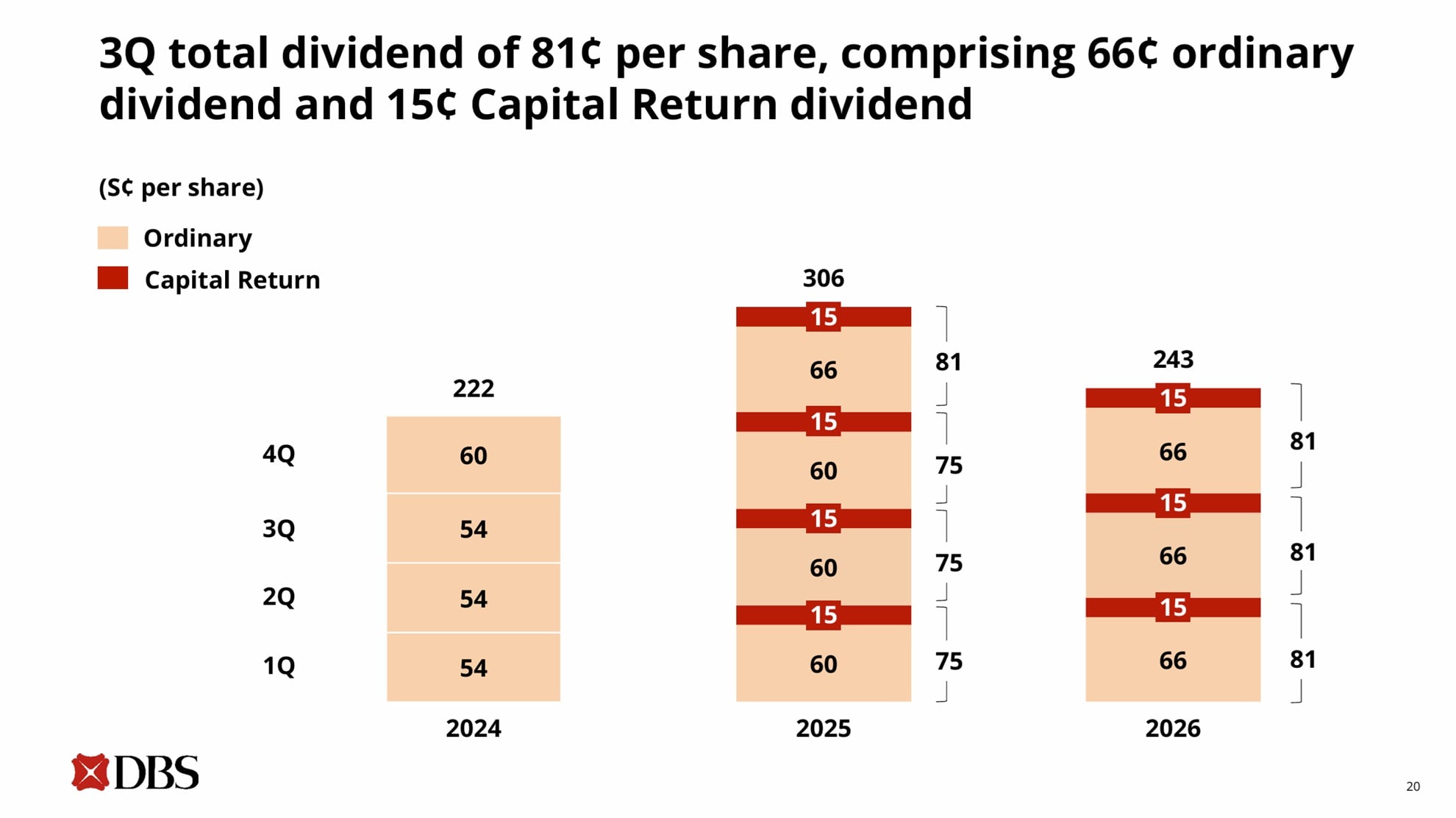
Table of Contents
For income investors like me, the dividend is often the most anticipated part of the results. DBS declared a total dividend of 81 cents per share for the third quarter of 2026. This is made up of an ordinary dividend of 66 cents and a capital return dividend of 15 cents. The dividend is one-tier tax exempt, so Singapore investors receive it free of tax.
For the first nine months of 2026, DBS has paid a total of S$2.43 per share, comprising S$1.98 in ordinary dividends and 45 cents in capital return dividends. If the fourth quarter dividend stays at 81 cents, the full year dividend for 2026 would be S$3.24 per share.
Here are the key dates for this dividend. The shares will go ex-dividend on Friday, 13 November 2026. The books closure date is 5.00 p.m. on 16 November 2026, and payment is expected on or about Tuesday, 24 November 2026. The scrip dividend scheme will not apply, so shareholders will receive cash.
I also like to check whether the dividend is sustainable. Based on the annualised third quarter earnings per share of S$3.93, actual earnings per share for the quarter were roughly 98 cents. The ordinary dividend of 66 cents therefore represents a payout ratio of about 67%, and the total dividend including the capital return represents about 82%. For the nine months, the ordinary dividends work out to about 64% of earnings. These are high payout ratios, but DBS has the capital strength to support them, and the capital return dividend is designed to hand excess capital back to shareholders over time rather than to be paid out of earnings forever.
DBS Dividend Yield and Valuation
The DBS share price closed at S$69.72 on 6 November 2026. Since DBS has paid 81 cents per share for each of the last four quarters, from the fourth quarter of 2025 to the third quarter of 2026, the trailing dividend of S$3.24 per share works out to a dividend yield of about 4.6%. If DBS keeps the quarterly dividend at 81 cents, the forward yield would be the same 4.6%.
It is worth separating the two parts of the dividend. The ordinary dividend of 66 cents per quarter, or S$2.64 a year, gives a yield of about 3.8% on its own. The capital return dividend of 15 cents per quarter adds roughly another 0.9%. Because the capital return is meant to distribute excess capital over a set period, I treat that portion as a bonus rather than something I can count on forever. Anyone buying DBS mainly for income should be comfortable with the 3.8% ordinary yield as the long-term base.
On valuation, DBS trades at about 2.8 times its net book value of S$24.47 per share. Based on annualised nine-month earnings per share of S$4.15, the price-to-earnings ratio is about 16.8 times. Using the weaker third quarter annualised figure of S$3.93, it rises to about 17.7 times. These are high multiples for a bank, and they reflect the premium investors place on the return on equity of around 17% that DBS delivers. The flip side is that there is less room for error if earnings disappoint.
Management Outlook for 2027
DBS management gave its guidance for 2027, while noting that the outlook has become more uncertain due to elevated energy prices, tighter financial conditions and geopolitical risks.
Management expects total income to grow in the mid-single-digit range in 2027. This assumes two more interest rate hikes by the United States Federal Reserve between now and the end of 2027, Sora averaging around 1.6%, and a stronger Singapore dollar. The bank estimates that each basis point change in Singapore interest rates affects net interest income by about S$10 million, which means a rise in local rates would help earnings.
The cost-to-income ratio is expected to be in the low-40% range, with expenses growing at a mid-single-digit pace. Specific allowances are assumed to be between 17 and 20 basis points of loans, and management pointed to its general allowance reserves as an ample buffer against risk.
In her comments, chief executive officer Tan Su Shan highlighted that the bank achieved record nine-month profit and a return on equity of 17% even though average Sora had halved. She added that a more supportive interest rate environment and continued growth in wealth management and institutional banking would benefit earnings, while strong capital and liquidity would provide resilience.
How DBS Fits Into My Stock Portfolio
DBS makes up 1.03% of my stock portfolio in terms of the amount I have invested. That is a relatively small position, which reflects the fact that I built it gradually rather than buying a large stake all at once. Because DBS has performed so well over the years, its share of the portfolio by market value is likely higher than its share by cost.
After going through the DBS 3Q 2026 financial results, I am comfortable continuing to hold my shares. The core customer business is growing, wealth management is going from strength to strength, asset quality is stable, and the dividend remains attractive. The weak third quarter was mainly caused by trading income, which I see as a temporary swing rather than a sign of deeper problems.
That said, I am mindful of a few risks. Interest rates remain the biggest swing factor for bank earnings, and the guidance relies on rates moving in a favourable direction. A sharp slowdown in the economy could push up bad loans. The Common Equity Tier 1 ratio has also been trending down as the balance sheet grows, though it remains well above regulatory requirements. I will keep an eye on these areas in future quarters.
If you would like to compare these numbers with earlier quarters, you can read my review of the DBS second quarter 2026 financial results and the DBS 3Q 2025 financial results. I have also compared the three local banks in my post on DBS vs UOB vs OCBC.
My Thoughts on DBS 3Q 2026 Financial Results
The DBS 3Q 2026 financial results showed a dip in quarterly profit, but the reasons behind it matter. Most of the decline came from markets trading income, which is volatile by nature. Meanwhile, the commercial book posted record income, net interest income grew despite much lower interest rates, wealth assets reached a new high on record inflows, and asset quality improved. The nine-month profit of S$8.82 billion is a record, and the 81 cents quarterly dividend remains generous, giving a yield of about 4.6% at a share price of S$69.72.
For long-term dividend investors in Singapore, I believe DBS continues to be a quality bank that rewards patience. As with any investment, it is worth looking beyond a single quarter and focusing on the long-term strength of the business. You can find the full results and presentation slides on the DBS investor relations page.
Disclaimer: This article is for informational purposes only and does not constitute financial advice. Please do your own research or consult a licensed financial adviser before making any investment decisions.