
Table of Contents
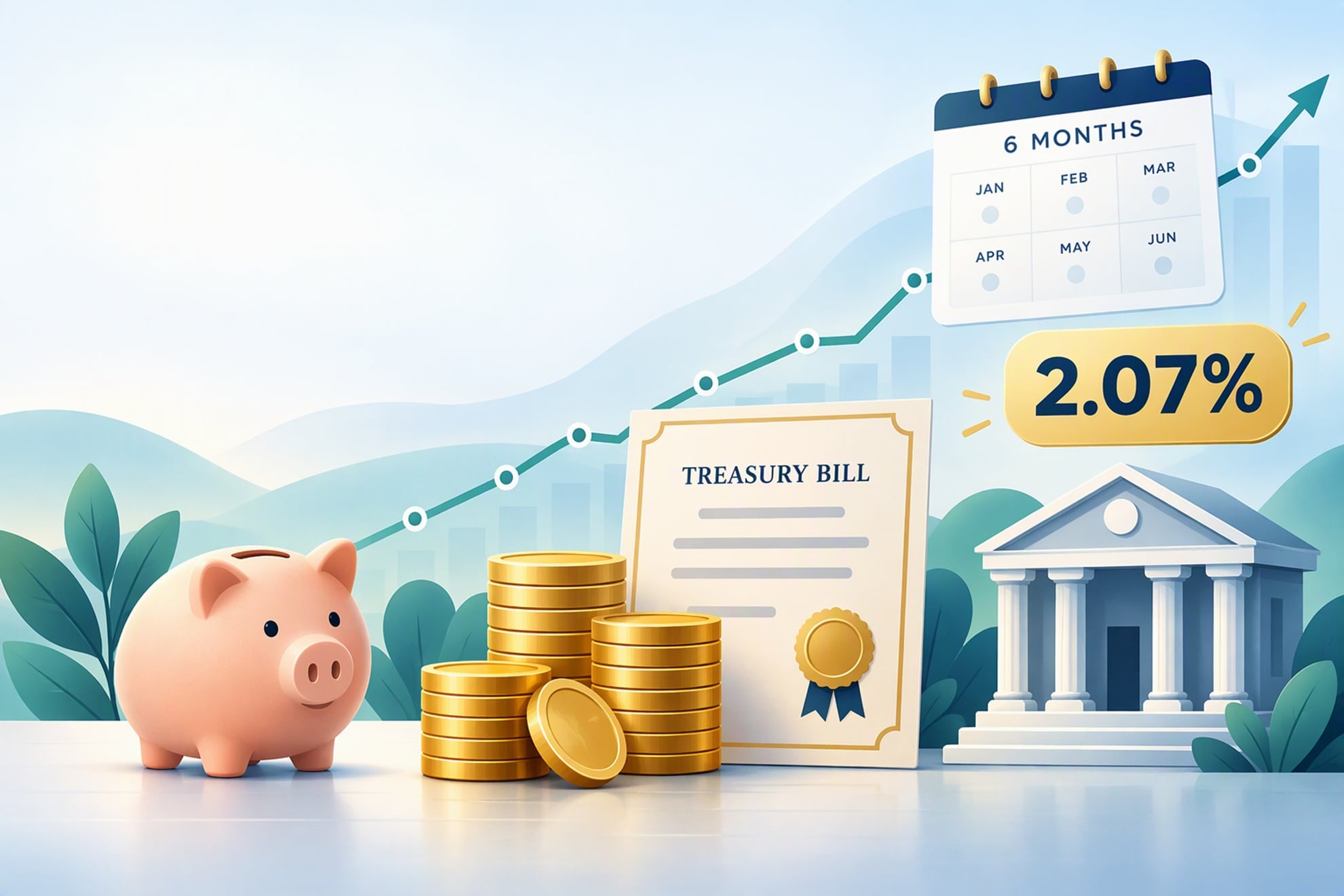
The BS26123A 6-month T-bill cleared at a cut-off yield of 2.07% per annum at its auction on 19 November 2026, which is the highest cut-off yield for a 6-month Singapore treasury bill this year. That is a clear step up from the 1.86% of the previous auction, and it puts treasury bills SG investors back in the conversation with fixed deposits and Singapore Savings Bonds. In this post, I explain the auction result, show what the yield means for a typical amount of cash, and compare it with the December 2026 Singapore Savings Bond and the best fixed deposit rates I tracked this month.
I keep a portion of my spare cash in short-term government instruments, so I follow each auction closely. I am not a licensed financial adviser, so please treat this post as education and not as personal advice, and always check the official sources before you apply for anything.
BS26123A 6-Month T-Bill Auction Results
The Monetary Authority of Singapore auctions the 6-month treasury bill every two weeks or so. The table below summarises the BS26123A auction. The auction figures come from the Monetary Authority of Singapore data as reported by Beansprout, and the issue and maturity dates are the ones I listed in my earlier T-bill post.
| Item | BS26123A |
|---|---|
| Auction date | 19 November 2026 |
| Issue date | 24 November 2026 |
| Maturity date | 25 May 2027 |
| Cut-off yield | 2.07% per annum |
| Average yield of bids | 1.88% per annum |
| Amount allotted | S$8.6 billion |
| Total applications | S$17.1 billion |
| Bid-to-cover ratio | 1.99 times |
| Previous cut-off yield (BS26122V, 4 November 2026) | 1.86% per annum |
The cut-off yield is the highest yield accepted by the Monetary Authority of Singapore at the auction. In a Singapore treasury bill auction, every successful bidder pays the same price, which is based on the cut-off yield. This means the 2.07% applies to everyone who received an allotment, including individuals who applied at the non-competitive rate. The lower average yield of 1.88% simply reflects that many bidders asked for a lower yield and still received their allocation.
You can verify the full set of numbers on the official Monetary Authority of Singapore auction page for BS26123A.
Why the BS26123A 6-Month T-Bill Yield Rose
Demand cooled at this auction. Total applications fell to S$17.1 billion from S$20.8 billion at the previous auction, while the amount allotted edged up from S$8.5 billion to S$8.6 billion. As a result, the bid-to-cover ratio dropped from 2.45 times to 1.99 times. When there are fewer bids for each dollar on offer, the auction has to clear at a higher yield to attract enough buyers.
Bidders also asked for more. The median submitted yield climbed to 2.00% from 1.80%, and the average yield rose to 1.88% from 1.63%. Beansprout links the move to expectations that United States interest rates could stay high for longer because of inflation concerns. That is the view of the author and not a confirmed cause, so I treat it as one plausible explanation rather than a fact.
For context, the yield has been climbing for most of the year. The 6-month T-bill was at 1.36% in February, 1.47% in June, 1.60% in late August, 1.92% in late September, and 1.95% in late October, before easing to 1.86% in early November and then jumping to 2.07%. My write-up on the previous auction, BS26122V, shows the earlier step in that path.
| Auction date | Cut-off yield |
|---|---|
| 12 February 2026 | 1.36% |
| 18 June 2026 | 1.47% |
| 27 August 2026 | 1.60% |
| 10 September 2026 | 1.70% |
| 24 September 2026 | 1.92% |
| 22 October 2026 | 1.95% |
| 4 November 2026 | 1.86% |
| 19 November 2026 (BS26123A) | 2.07% |
What a 2.07% T-Bill Yield Means for Your Money
A treasury bill does not pay interest during its life. You buy it at a discount to its face value of S$100 and receive the full face value at maturity, so the difference is your return. Over the 182 days from 24 November 2026 to 25 May 2027, a yield of 2.07% per annum works out to roughly S$103 of return for every S$10,000 you invest. This is my own estimate from the cut-off yield, so your actual figure depends on the exact cut-off price published by the Monetary Authority of Singapore.
The minimum application is S$1,000, and you can apply in multiples of S$1,000. Individuals can apply through the automated teller machines or internet banking portals of DBS or POSB, OCBC, and UOB for cash, through their Supplementary Retirement Scheme operator for SRS funds, or through their agent bank for money from the CPF Ordinary Account under the CPF Investment Scheme. Bank channels may close one to two business days before the auction, so check the exact cut-off time with your bank. My T-bills Singapore guide walks through the steps.
BS26123A 6-Month T-Bill vs Singapore Savings Bonds
Singapore Savings Bonds are the other government product that many savers weigh against a treasury bill. The December 2026 issue, which carries the code GX26120A, has a first-year interest rate of 1.83% and an average return of 2.39% per annum if you hold it for the full ten years. The rate rises each year, from 1.83% in year one to 2.83% in year ten. The issue date is 1 December 2026, and applications closed on 25 November 2026, so the December bond is no longer open. The next issue will be announced by the Monetary Authority of Singapore, and I cover this issue in my post on the SBDEC26 Singapore Savings Bond.
For a six-month holding period, the comparison is simple. The BS26123A 6-month T-bill locks in 2.07% per annum for six months, while the Singapore Savings Bond pays the first-year rate of 1.83% per annum if you redeem within the first year. On S$10,000, that is about S$103 for the treasury bill and about S$91 for the savings bond over six months, again based on my own simple calculation. The treasury bill is therefore higher by roughly S$12 on that amount.
The savings bond has other strengths that a number cannot capture. You can redeem it in any month without a penalty, and you receive the full principal back with the interest accrued, so it works as a flexible reserve. Its rate also steps up if you hold it longer, so it suits money that you may need at an unknown date. A treasury bill cannot be redeemed early with the Monetary Authority of Singapore, so you would have to sell it in the secondary market if you needed the cash, and the price you receive then can be different from what you expected. There is also a holding limit of S$200,000 per person for Singapore Savings Bonds, which I discuss in my post on maxing out my Singapore Savings Bonds limit.
BS26123A 6-Month T-Bill vs Fixed Deposits
Fixed deposits are the third option, and this month they are competitive. The rates below come from my best fixed deposit rates for November 2026 roundup, which I sourced from each bank’s own pages as of 9 November 2026. Promotional rates can change at any time, so please confirm them with the bank before you place a deposit.
| Bank | 6-month rate per annum | Minimum amount |
|---|---|---|
| CIMB (Personal Banking) | 2.20% | S$10,000 |
| RHB (Personal Banking) | 2.10% | S$20,000 |
| Maybank (standalone time deposit) | 2.10% | S$20,000 |
| Bank of China (S$20,000 tier) | 2.05% | S$20,000 |
| UOB | 1.60% | S$10,000 (fresh funds) |
| OCBC (online) | 1.55% | S$20,000 (fresh funds) |
| DBS and POSB (8 to 12 months) | 1.00% | S$1,000 to S$19,999 |
The best six-month fixed deposit rates are above the 2.07% treasury bill yield. CIMB at 2.20% beats it by 13 basis points, and RHB and Maybank at 2.10% are only slightly higher. On S$10,000 over six months, CIMB pays about S$110, RHB and Maybank pay about S$105, and the treasury bill pays about S$103. The local banks lag well behind, with UOB paying about S$80, OCBC about S$77, and DBS about S$50 on the same amount for six months. These are my own estimates using simple interest.
The fixed deposit promotions come with conditions that the BS26123A 6-month T-bill does not have. Several need fresh funds, which means money that is not already sitting with that bank. Most pay little or nothing if you withdraw early, and most roll over automatically at a much lower board rate, so you need to set a reminder before maturity. Deposits are also covered by the Singapore Deposit Insurance Corporation only up to S$100,000 per depositor per Scheme member, while treasury bills and savings bonds are backed by the Singapore government. If you are placing a large sum, that difference in safety deserves a place in your decision.
Side-by-Side Comparison
| Feature | BS26123A 6-month T-bill | Singapore Savings Bond (December 2026) | Fixed deposit (best 6-month promotion) |
|---|---|---|---|
| Rate | 2.07% per annum | 1.83% in year one, 2.39% average over ten years | Up to 2.20% per annum |
| Tenor | 6 months | Up to 10 years | 6 months |
| Estimated return on S$10,000 for six months | About S$103 | About S$91 | About S$110 at CIMB |
| Early access | No early redemption with the Monetary Authority of Singapore | Redeem any month without penalty | Usually forfeits interest if withdrawn early |
| Backing | Singapore government | Singapore government | Bank, insured up to S$100,000 |
| Minimum amount | S$1,000 | S$500 | S$10,000 to S$20,000 for the best rates |
Which One Suits You
I would match the product to the purpose of the money. If you have an emergency fund or money that you might need at short notice, the Singapore Savings Bond offers the best flexibility because you can redeem it at any time without a penalty, even though its first-year rate is the lowest of the three. If you know that you will not need the cash for six months, both the treasury bill and a good fixed deposit work, and the choice then comes down to a few dollars of extra interest against the safety and simplicity of a government product.
The fixed deposit wins on raw rate this month, but only if you are willing to open or fund an account at CIMB, RHB, or Maybank and meet the minimum. The BS26123A 6-month T-bill wins if you want a government-backed return with a low minimum and you prefer to apply through the bank you already use. All three are free of tax for individuals in Singapore, so you do not need to adjust the rates for tax.
These instruments are for the safe part of my savings. They do not replace the long-term growth that I aim for with the dividend stocks in my stock portfolio, but they are a good home for cash that I will need within the next year. If you want to look beyond these three, my post on the best savings account besides T-bills, Singapore Savings Bonds and fixed deposits covers high-interest accounts that do not lock in your money.
What to Watch After the BS26123A 6-Month T-Bill Auction
BS26123A has already been issued, so applications for it are closed. The next 6-month treasury bill auction should follow in early December, and you can find the exact dates on the Monetary Authority of Singapore auctions and issuance calendar. The key signals will be the bid-to-cover ratio and the median bid. If demand recovers toward the 2.45 times seen at the previous auction, the cut-off yield could ease again, while weaker demand could keep it near or above 2%.
Because the fixed deposit promotions have also risen this month, the gap between treasury bills and the best bank rates is narrow. I would not chase a few basis points. Instead, I look at how long I can leave the money untouched and how much safety I want, then choose the product that fits.
BS26123A 6-Month T-Bill FAQ
What was the cut-off yield for BS26123A?
The cut-off yield was 2.07% per annum, set at the auction on 19 November 2026.
When does BS26123A mature?
The bill matures on 25 May 2027, 182 days after its 24 November 2026 issue date.
Can I still apply for BS26123A?
No. The auction closed on 19 November 2026 and the bill was issued on 24 November 2026. You can apply for the next 6-month treasury bill auction instead.
Is the BS26123A 6-month T-bill better than a fixed deposit?
The yield of 2.07% is below the best six-month fixed deposit promotions of about 2.10% to 2.20%, but above the rates at UOB, OCBC, DBS, and POSB. The treasury bill has the advantage of government backing and a lower minimum, while the fixed deposits may need fresh funds and a higher minimum.
Conclusion: BS26123A 6-Month T-Bill and Your Cash
The BS26123A 6-month T-bill delivered a cut-off yield of 2.07%, the best result for a 6-month treasury bill in 2026, and it works out to roughly S$103 for every S$10,000 over six months. It beats the first-year rate of the December 2026 Singapore Savings Bond at 1.83% and most local bank fixed deposits, but it trails the best promotions at CIMB, RHB, and Maybank by a small margin. The right choice depends on how soon you may need the money, how much safety you want, and whether you can meet the minimum for the best fixed deposit rates. Compare all three before you apply, and verify every figure on the official sources.
Disclaimer: This is not a sponsored post, and the opinions are solely based on My Sweet Retirement’s own research. Auction results are based on Monetary Authority of Singapore data as reported by Beansprout, Singapore Savings Bond figures are based on the December 2026 issue, fixed deposit rates are from each bank’s official pages as of 9 November 2026, and the return estimates are my own calculations. Always verify directly on the Monetary Authority of Singapore auctions and issuance calendar and with the banks before making any decision.