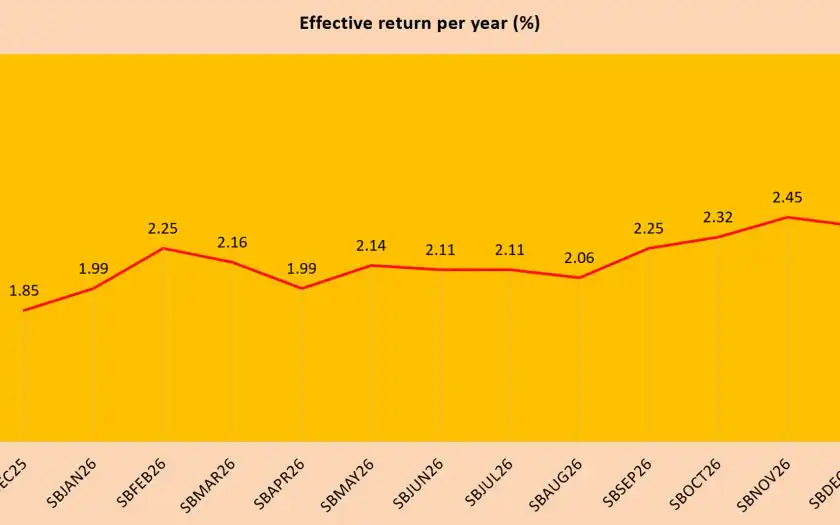
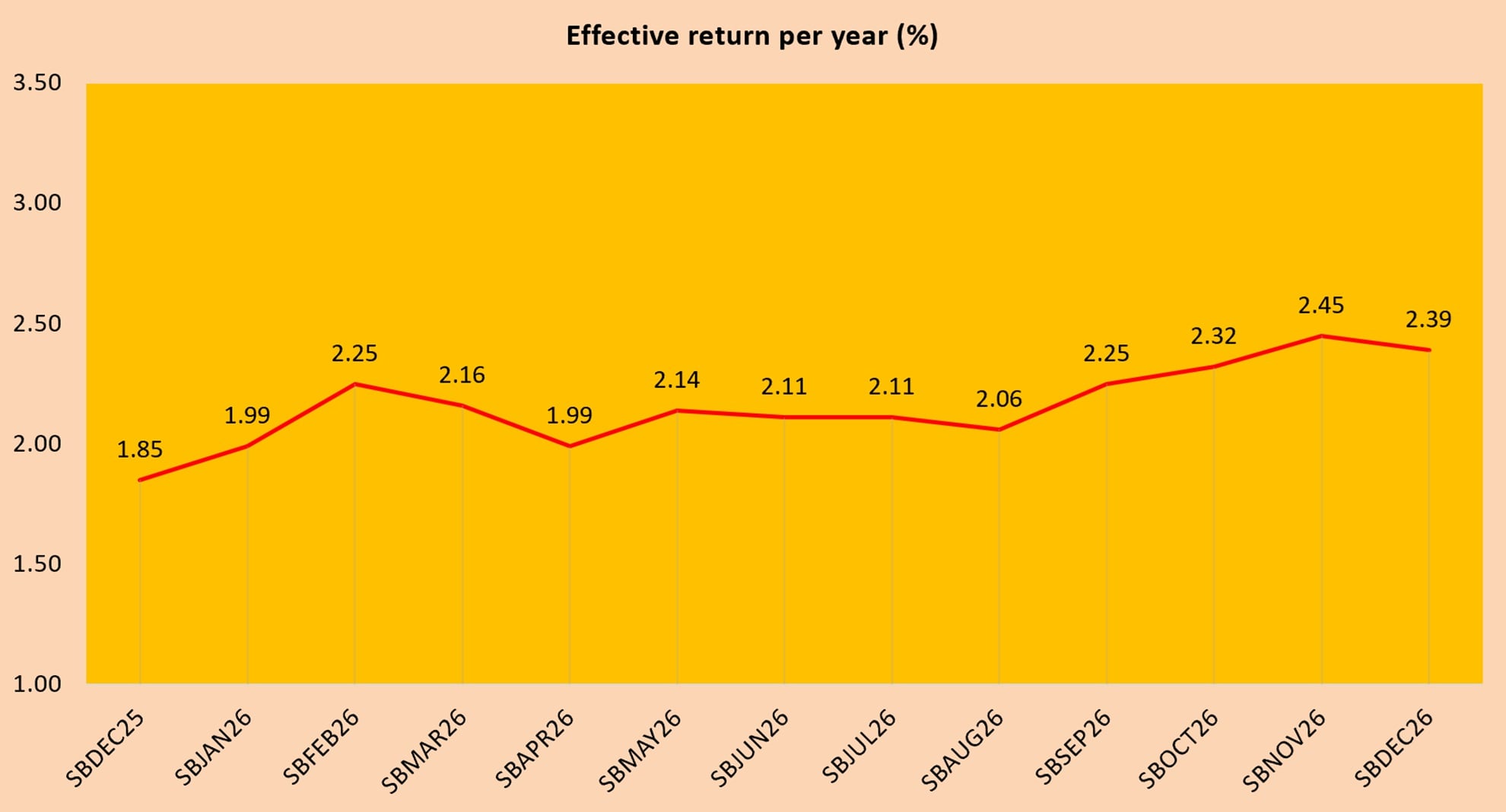
 The December 2026 Singapore Savings Bond, SBDEC26 GX26120A, offers a 10-year average return of 2.39% per annum, which is a little lower than the 2.45% offered by the November issue. After three consecutive monthly increases, this is the first time in four months that the headline Singapore Savings Bond rate has eased.
Table of Contents
What makes this issue interesting is that the headline number does not tell the full story. The first-year interest rate has actually gone up, from 1.67% on SBNOV26 to 1.83% on SBDEC26. It is the later years that have come down, with the tenth-year rate dropping from 3.08% to 2.83%. In other words, the December 2026 Singapore Savings Bond pays more upfront but rewards long-term holders slightly less than the issue before it.
I treat Singapore Savings Bonds as the safe anchor of my finances. They hold part of my emergency fund and the cash I want to keep stable while the rest of my money is invested elsewhere, including my stock portfolio. In this post, I will walk through the full interest rate table, the key dates, how SBDEC26 compares with recent issues, Treasury bills and fixed deposits, and whether it makes sense to apply this month.
What is a Singapore Savings Bond?
A Singapore Savings Bond, or SSB, is a type of Singapore Government Security created specifically for individual investors. It is fully backed by the Singapore Government, which makes it one of the safest places in Singapore to keep savings that you do not want exposed to market swings.
Two features set the Singapore Savings Bond apart from ordinary bonds. The first is the step-up interest structure, where the interest rate starts low and rises each year that you continue to hold the bond. The second is flexibility. You can redeem your SSB in any month without a penalty, and you receive your full principal back together with any interest earned up to that point. There is no need to sell the bond on the open market, so you never face the risk of selling at a loss.
Each Singapore Savings Bond has a tenor of about 10 years, and interest is paid every six months straight into your bank account or SRS account. Interest from Singapore Government Securities issued up to the end of 2028 also falls under the Qualifying Debt Securities scheme, so individual investors generally do not pay tax on it.
Minimum Investment and Holding Limit
The minimum investment for a Singapore Savings Bond is only S$500, and you can apply in multiples of S$500 after that. This low entry point makes the SSB accessible to almost anyone, from students putting aside their first savings to retirees managing a large cash pile.
Each individual can hold up to S$200,000 in Singapore Savings Bonds at any one time. This limit covers all SSB issues combined and includes both cash and SRS applications. If you already hold older Singapore Savings Bonds, check how much room you have left under the limit before you apply for SBDEC26 GX26120A.
SBDEC26 GX26120A Interest Rate Table
Here is the full step-up schedule for the December 2026 Singapore Savings Bond, together with the interest you would earn each year on a S$10,000 investment.
| Year from Issue | Interest Rate | Interest on S$10,000 |
| 1 | 1.83% | S$183 |
| 2 | 1.99% | S$199 |
| 3 | 2.17% | S$217 |
| 4 | 2.35% | S$235 |
| 5 | 2.47% | S$247 |
| 6 | 2.52% | S$252 |
| 7 | 2.57% | S$257 |
| 8 | 2.63% | S$263 |
| 9 | 2.71% | S$271 |
| 10 | 2.83% | S$283 |
If you put S$10,000 into SBDEC26 GX26120A and hold it for the full 10 years, you would receive about S$2,407 in total interest. Because the interest steps up over time, the average return per year depends on how long you hold the bond. It works out to about 1.91% per annum if you hold for two years, 2.16% per annum after five years, 2.30% per annum after eight years and 2.39% per annum if you hold all the way to maturity.
This is the main thing to understand about any Singapore Savings Bond. The longer you hold it, the closer you get to the headline rate. If you are likely to redeem within a year or two, the first-year and second-year rates matter far more to you than the 10-year average.
SBDEC26 GX26120A Issue Details
| Issue code | GX26120A (SBDEC26) |
| Amount offered | S$500 million |
| Opening date | 2 November 2026, 6pm |
| Closing date | 25 November 2026, 9pm |
| Allotment date | 26 November 2026 |
| Issue date | 1 December 2026 |
| Maturity date | 1 December 2036 |
| Interest payment dates | Every six months, on 1 June and 1 December |
| First interest payment | 1 June 2027 |
The amount offered for this issue has been raised to S$500 million, compared with S$400 million for the November issue. A larger issue size means a better chance of getting your full application amount, even if demand picks up.
How SBDEC26 Compares to the November 2026 Issue
Comparing SBDEC26 GX26120A with SBNOV26 GX26110X shows a clear change in shape. The first-year rate is higher on December at 1.83% versus 1.67%. The second-year rate is almost the same at 1.99% versus 2.00%. From the third year onwards, every annual rate on SBDEC26 is lower, and the gap widens the further out you go. By the tenth year, the December issue pays 2.83% compared with 3.08% on the November issue.
The result is a 10-year average of 2.39% per annum, down from 2.45%. The SSB interest rate still remains well above the levels seen in the first half of 2026, when 10-year averages were hovering around 2.1%. So while this issue marks a small step back, rates are still in the higher range of what we have seen this year.
What the Flatter Rate Curve Tells Me
Singapore Savings Bond rates are not set at random. MAS bases each issue on the average yields of Singapore Government Securities in the month before the announcement. The short-term years of the SSB follow short-term government bond yields, while the later years follow longer-term yields such as the 10-year government bond.
A higher first-year rate together with lower later-year rates suggests that short-term Singapore Government Securities yields went up during October 2026, while longer-term yields eased. The gap between short-term and long-term rates has narrowed, which is what investors call a flatter yield curve. For me as a saver, the practical takeaway is simple. SBDEC26 is slightly more attractive than SBNOV26 if I only plan to hold for a year or two, and slightly less attractive if I plan to hold for the full decade.
SBDEC26 GX26120A Versus T-Bills and Fixed Deposits
Before I apply for any Singapore Savings Bond, I always compare it with the other safe options available. The most recent 6-month Treasury bill, BS26122V, cleared at a cut-off yield of 1.86% per annum at its auction on 4 November 2026. That is just a touch higher than the 1.83% first-year rate on SBDEC26 GX26120A.
On a pure one-year yield basis, the T-bill and the SSB are almost neck and neck. The difference lies in flexibility and certainty. A T-bill locks your money for six months and then you need to reinvest at whatever the next yield happens to be. A Singapore Savings Bond lets you exit in any month, and it guarantees rising rates for up to 10 years if you stay invested. If you want a refresher on how T-bills work, my Singapore Treasury bills guide covers the details.
Fixed deposits are worth checking too. Bank promotions change often and sometimes beat both T-bills and SSBs for short tenors, but they usually require you to lock in your money for a fixed period and may come with conditions such as fresh funds or minimum deposits. You can compare the latest offers in my roundup of the best fixed deposit rates and my list of the best savings accounts in Singapore.
Who Is the December 2026 Singapore Savings Bond Suitable For?
SBDEC26 GX26120A suits investors who value safety and predictability over high returns. Conservative investors, retirees and those approaching retirement may find it a useful way to keep part of their savings stable while still earning a reasonable return. Because there is no penalty for early redemption, it also works well as a home for an emergency fund, where access to cash matters more than squeezing out every last basis point.
Younger investors can also benefit. If you are building up savings for a home, a wedding or further studies within the next few years, the Singapore Savings Bond gives you a safe place to park the money with a slightly better return than a typical savings account. For investors with a large equity allocation, SSBs act as a buffer that does not fall in value when the stock market drops.
That said, the SSB is not built for growth. Over the long run, a diversified portfolio of stocks, REITs or ETFs is likely to outperform government bonds. I see the SSB as one part of a balanced plan rather than the whole plan.
Should I Switch from an Older SSB?
Many readers ask whether it is worth redeeming an older Singapore Savings Bond to buy a new one. The answer depends on the rates you are getting on the bond you already hold. If your existing SSB was bought during the high-rate period between late 2022 and 2024, its remaining step-up rates are likely to be higher than what SBDEC26 offers, so there is little reason to switch.
If you hold an SSB from a lower-rate month, such as some issues from 2025 or early 2026, switching could make sense. The fairest way to compare is to look at the average return you would earn over the years you have left on the old bond, and compare that with the average return on SBDEC26 for the same number of years. The MAS Savings Bonds calculator is useful for this.
Keep the timing in mind. Redemption requests for this round close at the same time as applications, at 9pm on 25 November 2026, and redemption proceeds are only paid out early in the following month. Since you must pay for a new application upfront, you will need spare cash to cover SBDEC26 while you wait for the proceeds from your old bond.
How to Apply for SBDEC26 GX26120A
You can apply for SBDEC26 GX26120A with cash through DBS or POSB, OCBC or UOB internet banking, mobile banking applications or ATMs. A S$2 transaction fee applies to each application. To apply with cash, you need an individual CDP Securities Account with Direct Crediting Service linked to your bank account.
If you want to use your Supplementary Retirement Scheme funds, apply through the internet banking portal of your SRS operator, or the DBS mobile banking application if your SRS account is with DBS. CPF savings cannot be used to buy Singapore Savings Bonds.
Applications are accepted from 7am to 9pm, Monday to Saturday, excluding public holidays, and close at 9pm on 25 November 2026. Allotment results are released on 26 November 2026, and the bond is issued on 1 December 2026.
SBDEC26 GX26120A FAQ
What is the interest rate for SBDEC26 GX26120A?
The interest rate starts at 1.83% in the first year and steps up to 2.83% in the tenth year, giving an average return of 2.39% per annum if you hold the bond for the full 10 years.
When is the closing date for the December 2026 Singapore Savings Bond?
Applications close at 9pm on 25 November 2026. Allotment results are announced on 26 November 2026, and the bond is issued on 1 December 2026.
Is SBDEC26 better than SBNOV26?
It depends on how long you plan to hold. SBDEC26 pays a higher first-year rate of 1.83% compared with 1.67%, but its 10-year average of 2.39% is lower than the 2.45% offered by SBNOV26.
Can I redeem SBDEC26 GX26120A early?
Yes. You can redeem in any month with no penalty and receive your full principal plus the interest earned up to that point.
Can I use CPF to buy Singapore Savings Bonds?
No. Only cash and SRS funds can be used.
Final Thoughts on SBDEC26 GX26120A
SBDEC26 GX26120A offers a 10-year average return of 2.39% per annum, a small dip from last month, but with a noticeably better first-year rate of 1.83%. For savers who might need their money within the next couple of years, the December issue is actually the more attractive of the two most recent Singapore Savings Bonds. For those planning to hold for the full decade, SBNOV26 was slightly better, but SBDEC26 still offers a solid, government-backed return with complete flexibility.
With the issue size raised to S$500 million, I expect most applicants to receive their full allocation. I plan to keep using Singapore Savings Bonds as the stable core of my cash savings, and SBDEC26 GX26120A fits that role well. Remember to submit your application before 9pm on 25 November 2026.
Disclaimer: This is not a sponsored post, and the opinions are solely based on My Sweet Retirement’s own research. Rates and terms are correct as of the time of writing. Always verify the details directly on the MAS Singapore Savings Bonds page before applying.