

UOB delivered a steady and resilient set of financial results for the second quarter of 2026, reinforcing its position as one of Singapore’s strongest and most regionally diversified banks. As an investor who holds UOB as 2.94% of my stock portfolio, I always pay close attention to how the bank performs each quarter, especially in a year marked by shifting interest rate expectations, softer loan margins and heightened global uncertainty. With the UOB share price closing at S$41.95 on Wednesday, 12 August 2026, this latest set of UOB Second Quarter 2026 Results provides meaningful insight into how the bank is navigating the current environment and where future opportunities may lie.
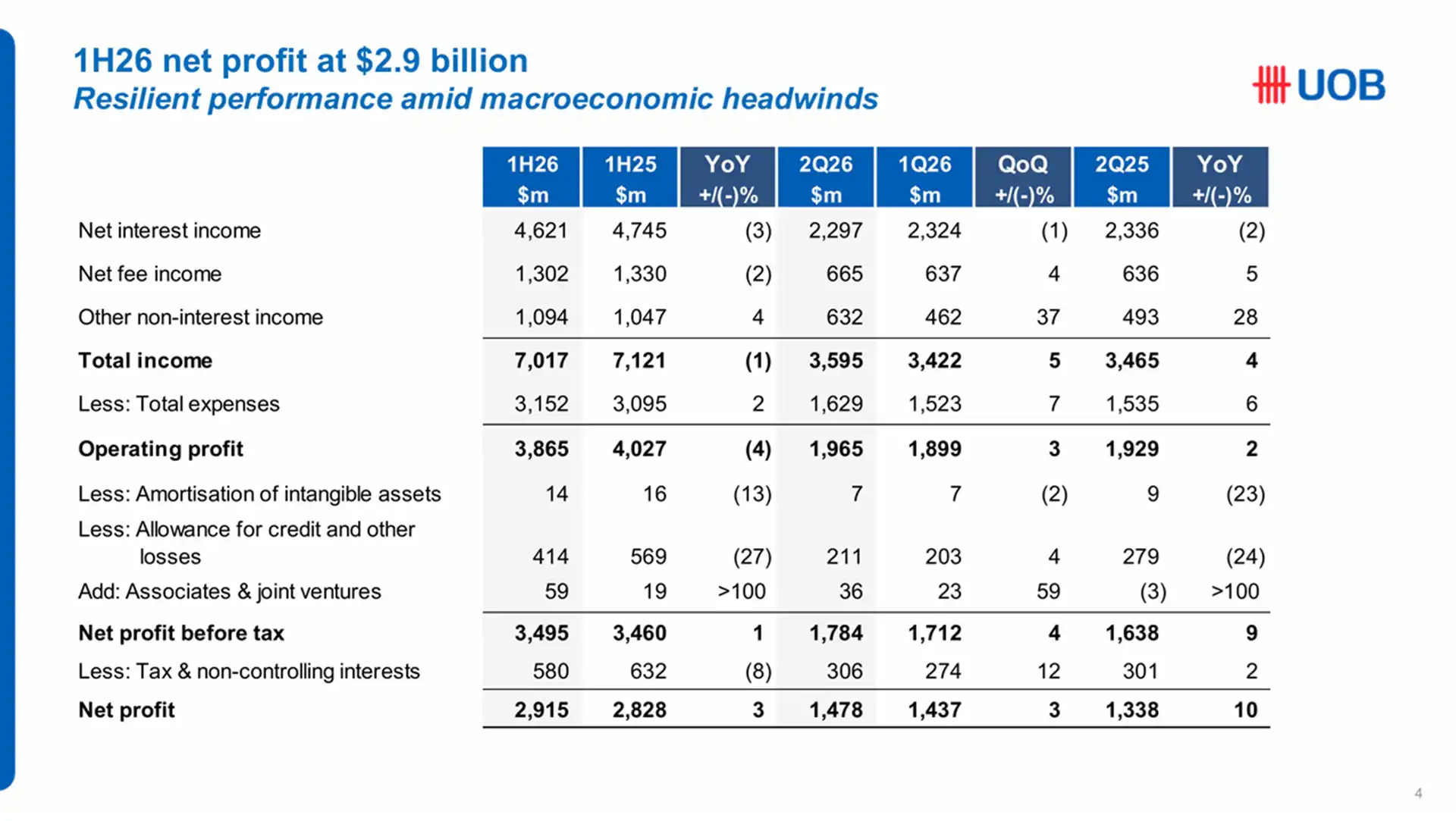
UOB reported a net profit of S$1.5 billion for 2Q26, representing a 10% increase year on year and a 3% rise quarter on quarter. This growth was supported by strong wealth management momentum, resilient treasury income and disciplined cost management. The bank’s diversified franchise across ASEAN continues to be a major strength, helping offset margin pressures arising from the lower interest rate backdrop. As the bank expands its regional capabilities and deepens customer engagement, its earnings profile remains stable and well‑supported.
The bank’s performance in the first half of 2026 also reflects this resilience. UOB recorded S$2.9 billion in net profit for 1H26, up 3% from a year ago, even as net interest income moderated slightly due to margin compression. The bank’s ability to maintain profitability despite these headwinds highlights the strength of its diversified business model and its disciplined approach to balance sheet management.
Understanding the UOB Second Quarter 2026 Results
Net Interest Income and Margin Trends
Net interest income for 2Q26 came in at S$2.3 billion, a slight decline of 1% quarter on quarter and 2% year on year. The key driver behind this moderation was the narrowing of net interest margin (NIM), which fell eight basis points from the previous quarter to 1.74%. This decline was attributed to lower asset yields amid a softer interest rate environment, as well as the impact of balance sheet mix changes and surplus fund deployment.
The bank’s NIM performance reflects broader industry trends, where lower benchmark rates have compressed loan yields. Despite this, UOB managed to cushion the impact through loan growth of 2% quarter on quarter and active funding cost management. Average interest‑bearing assets continued to expand, rising from S$517 billion in 1Q26 to S$528 billion in 2Q26, supporting overall net interest income stability.
Strong Fee Income Driven by Record Wealth Management Fees
One of the standout highlights of UOB’s 2Q26 results was the strength of its fee income. Net fee income rose to S$665 million, up 4% quarter on quarter and 5% year on year. Wealth management fees reached a record high, driven by sustained client engagement, strong demand for investment products and continued growth in assets under management (AUM).
Wealth management income for 1H26 grew 16% year on year, supported by rising invested AUM and positive net new money inflows. High‑net‑worth AUM reached S$204 billion, up 7% from a year ago. Across ASEAN‑4 markets, wealth management income surged 30% year on year, underscoring UOB’s growing regional franchise and its ability to capture rising customer flows.
Credit card income also grew 13% year on year, supported by robust card billings and strong customer engagement across lifestyle offerings. Retail deposits rose 2%, with CASA balances increasing 4% despite the lower interest rate backdrop.
Non‑Interest Income Boosted by Divestment Gains
Other non‑interest income rose significantly to S$632 million in 2Q26, up 37% quarter on quarter and 28% year on year. This increase was partly driven by non‑recurring gains from asset divestments, which helped offset lower trading and investment income amid reduced market opportunities.
Customer‑related treasury income remained resilient, supported by healthy demand for hedging solutions. This segment continues to be an important contributor to UOB’s diversified earnings base, especially during periods of market volatility.
Cost Management and Operating Efficiency
Total expenses for 2Q26 rose 7% quarter on quarter to S$1.6 billion, reflecting continued investments in technology, talent and strategic business priorities. Despite this increase, UOB maintained a cost‑to‑income ratio of 45.3%, which remains within a healthy range for a regional bank of its scale.
For 1H26, total expenses increased modestly by 2% year on year, demonstrating disciplined cost management even as the bank invests in long‑term growth initiatives. Staff costs and IT‑related expenses rose in line with the bank’s strategic focus on digital capabilities and customer experience enhancements.
Asset Quality and Credit Costs
UOB’s asset quality remained stable, with the non‑performing loan (NPL) ratio holding at 1.6%. New NPA formation in 2Q26 was mainly due to the downgrade of a closely monitored real estate account in Greater China. Despite this, overall credit costs remained within expectations at 28 basis points.
Total allowance for 1H26 declined 27% year on year to S$414 million, supported by the release of general allowance that offset specific allowance for the real estate account. NPA coverage stood at 88%, or 306% after taking collateral into account, reflecting adequate provision buffers.
Capital, Liquidity and Funding Strength
UOB maintained a strong capital position, with its Common Equity Tier 1 (CET1) ratio at 15.4% as of June 2026. This remains comfortably above regulatory requirements and provides the bank with ample flexibility to support business growth and shareholder returns.
Liquidity also remained robust, with an all‑currency Liquidity Coverage Ratio (LCR) of 159% and a Net Stable Funding Ratio (NSFR) of 114%. These metrics underscore the bank’s prudent balance sheet management and its ability to navigate uncertain market conditions.
UOB Dividend and Current Dividend Yield
UOB’s total dividend for FY25 was S$1.56 per ordinary share. Based on the uob share price of S$41.95 as at Wednesday, 12 August 2026, the current dividend yield can be calculated as follows:
Dividend Yield = 1.56 ÷ 41.95
Dividend Yield = 0.0372, or approximately 3.72%
A dividend yield of 3.72% is attractive for income‑focused investors, especially given UOB’s consistent payout ratio of around 50% and its strong capital position. The uob dividend track record has been stable, supported by resilient earnings and disciplined capital management.
Segment Performance Across Retail and Wholesale Banking
Group Retail delivered stable income of S$2.57 billion for 1H26, supported by strong wealth management growth, rising card billings and steady deposit inflows. Wealth income rose 16% year on year, while credit card income increased 13%. CASA balances grew 4%, improving the CASA mix to 58%.
Group Wholesale Banking recorded income of S$2.91 billion for 1H26, with transaction banking contributing close to half of total wholesale income. Trade loans grew 33% year on year, supported by strong regional demand. CASA balances in wholesale banking rose 9%, reflecting robust client activity across ASEAN.
Cross‑border income remained stable at 28% of total wholesale banking income, highlighting UOB’s strength in regional connectivity and its ability to support customers’ cross‑border ambitions.
Pros and Cons of UOB’s 2Q26 Financial Results
UOB’s second quarter results present a balanced picture of resilience, growth and prudent risk management. On the positive side, net profit growth was strong, supported by record wealth management fees, resilient treasury income and disciplined cost control. The bank’s diversified franchise across ASEAN continues to be a major strength, helping offset margin pressures and supporting stable earnings. Asset quality remained manageable, with adequate provision buffers and stable NPL ratios. Capital and liquidity positions were robust, providing confidence in the bank’s ability to sustain its uob dividend payouts.
On the other hand, net interest margin compression remains a key challenge, reflecting the lower interest rate environment and competitive pressures in loan pricing. Loan‑related fees softened due to weaker capital market activities, and specific allowance increased due to the downgrade of a real estate account in Greater China. Cost pressures also rose slightly due to ongoing investments in technology and strategic priorities.
Based on the UOB Share Price, Would I Buy UOB Now?
With the uob share price at S$41.95, UOB offers a compelling blend of stability, regional growth potential and consistent dividends. The current uob dividend yield of 3.72% is attractive, especially given the bank’s strong capital position and disciplined payout strategy. UOB’s diversified earnings base, strong wealth management momentum and resilient wholesale banking franchise position it well for long‑term growth.
However, margin pressures may persist in the near term, and credit risks in certain markets such as Greater China warrant monitoring. For long‑term investors seeking stability, regional exposure and consistent dividends, UOB remains a solid banking stock. While I am not a financial advisor, and investors should always consult a qualified professional, UOB’s fundamentals suggest that it continues to be a dependable holding for portfolios seeking steady returns.