

On 22nd October 2024, Mapletree Logistics Trust announced its 2QFY24/25 Financial Results. As shared by the manager in the previous quarter, the trust’s strategy is to divest assets with older specifications and of limited redevelopment potential as part of their portfolio rejuvenation. Mapletree Logistics Trust had completed the divestments of 119 Neythal Road in Singapore and Flexhub in Malaysia. The divestment of another 3 properties (Linfox, Celestica Hub and Zentraline) in Malaysia are pending completion.
How has Mapletree Logistics Trust perform as compared to the previous quarter? Let us take a detailed look below to see how its portfolio rejuvenation has worked out.
Mapletree Logistics Trust 2QFY24/25 Financial Results
With the absence of revenue contribution from divested properties and currency weakness (mainly JPY, KRW and VND), Mapletree Logistics Trust’s Gross Revenue fell 1.8% year-on-year to S$183.3 million. The decline was mitigated by higher contribution from Singapore and Australia, and contribution from acquisitions completed in 1Q FY24/25 and 4Q FY23/24.
Similar to the above reasons, Net Property Income follow suite and decline by 2.1% year-on-year to S$158.6 million.
Borrowing costs increased 8.2% year-on-year because of higher average interest rate on existing debts and incremental borrowings to fund 1Q FY24/25 and 4Q FY23/24 acquisitions. These were partly offset by loan repayments with proceeds from divestments.
Notwithstanding the weakness, Distribution Per Unit (DPU) to unitholders declined 10.6% to 2.027 cents.
| 2QFY24/25 (S$’000) |
2QFY23/24 (S$’000) |
% Change | |
| Gross Revenue | 183,304 | 186,694 | (1.8) |
| Property Expenses |
(24,708) | (24,710) | 0 |
| Net Property Income | 158,596 | 161,984 | (2.1) |
| Borrowing Costs | (39,823) | (36,822) | 8.2 |
| Amount Distributable | 109,183 | 118,629 | (8.0) |
| Distribution Per Unit (“DPU”) (cents) | 2.027 | 2.268 | (10.6) |
Debt

In this section, let us take a look at Mapletree Logistics Trust’s debt. In 2Q FY24/25, Mapletree Logistics Trust’s aggregate leverage increased from previous quarter of 39.6% to 40.2%. This is slightly on the high side, and we need to keep a close watch on this closely.
As you can see from the above presentation slide, its debt maturity profile remains well-staggered with healthy average debt duration of 3.6 years. The manager assured that there is ample liquidity with available committed credit facilities of S$987 million to refinance S$865 million (or 15% of total debt) debt due in FY24/25 and FY25/26.
Having a well-staggered debt maturity profile is crucial for REITs to manage their debt obligations effectively. By spreading out debt repayments over different time periods, REITs can avoid liquidity crunches and reduce the risk of default.
Furthermore, a well-staggered debt maturity profile allows REITs to take advantage of changes in interest rates. For example, if interest rates drop, REITs with debt maturing in the future can refinance at lower rates, reducing their interest expenses.
Overall, maintaining a well-staggered debt maturity profile is a sound financial strategy that can help ensure the long-term sustainability of the REIT’s finances.
Occupancy

In this quarter, Mapletree Logistics Trust’s portfolio occupancy improved to 96.0%. This was largely due to backfilling of space in Hong Kong SAR, Vietnam and South Korea.
Next, let us take a look a its rental reversion and see if Mapletree Logistics Trust is still able to keep it positive.

As you can see above, most markets maintained their positive rental reversions except for China. Excluding China, portfolio rental reversion was positive 3.6%. China remains challenging and negative rental reversions are expected to continue.
Do you know what is rental reversion? Rental reversion refers to the change in rental rates when leases are renewed. A positive rental reversion means the new rental rate is higher than the previous rate. A negative rental reversion happens when the new rental rate is lower than the previous rate. Whether the rental reversion is positive or negative depends on the market demand and supply.
Lease Expiry
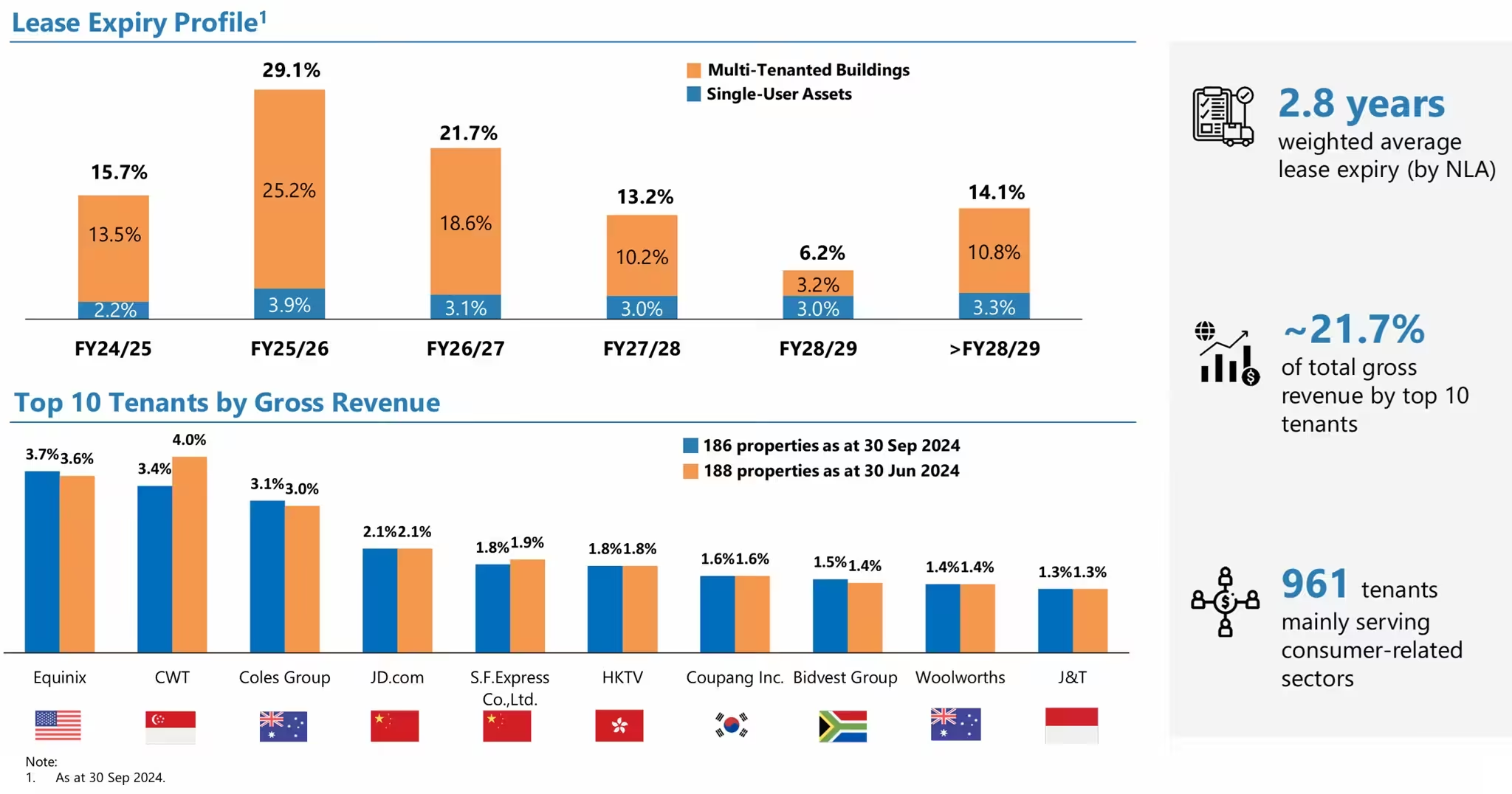
Weighted average lease expiry for the portfolio stood at approximately 2.8 years. As you can see from the chart above, overall lease expiry remains well staggered.
Mapletree Logistics Trust Share Price and Dividend Yield

As you can see from the above chart, Mapletree Logistics Trust share price has been on the downtrend over the past 6 months. However, the share price started its decline in October. Mapletree Logistics Trust share price currently stood at S$1.37 on Friday, 25th October 2024.
Based on the Mapletree Logistics Trust dividend of 9.003 cents in FY23, Mapletree Logistics Trust’s current dividend yield is 6.57%.
Do you know how to calculate the current dividend yield? The formula for calculating the current dividend yield is straightforward. It is calculated by dividing the annual dividends per share by the current market price per share. Here is the formula in mathematical terms:

Summary of Mapletree Logistics Trust 2QFY24/25 Financial Results
By now, I believe you should have the sentiment that current quarter result is pretty negative. Let me summarize the pro and cons.
The pros are:
- Healthy average debt duration of 3.6 years with ample liquidity with available committed credit facilities of S$987 million to refinance S$865 million (or 15% of total debt) debt due in FY24/25 and FY25/26.
- Portfolio occupancy improved to 96.0%.
- Excluding China, portfolio rental reversion was positive 3.6%. Lease expiry remains well staggered
- High current dividend yield is 6.57%.
The cons are:
- Gross Revenue and Net Property Income fell 1.8% and 2.1% year-on-year respectively.
- Distribution Per Unit fell 10.6% year-on-year.
- Portfolio rental reversion was negative -0.6%.
- High gearing ratio of 40.2%.
With every portfolio rejuvenation, it will take time to see value delivered to unitholders. Having said that, will you buy Mapletree Logistics Trust right now?