AMD’s 1Q 2026 results kicked off the year with an exceptionally strong first quarter, delivering numbers that underscore its growing leadership in high-performance computing and artificial intelligence infrastructure. As someone who holds AMD as 3% of my US stock portfolio in terms of amount invested, these results are particularly meaningful because they highlight how the company is positioning itself in one of the fastest-growing segments of the semiconductor industry.
The quarter further emphasizes the company’s strategic focus on AI technologies and infrastructure development.
The first quarter of 2026 was defined by accelerating AI adoption, expanding data centre deployments, and continued momentum across AMD’s core businesses. Revenue reached approximately $10.3 billion, a substantial increase from the prior year, supported by broad-based strength across Data Centre, Client, Gaming, and Embedded segments. The company’s ability to scale its product portfolio and deepen strategic partnerships has clearly paid off, and the numbers reflect that. These results illustrate how the company is adapting to the evolving landscape of technology demands.
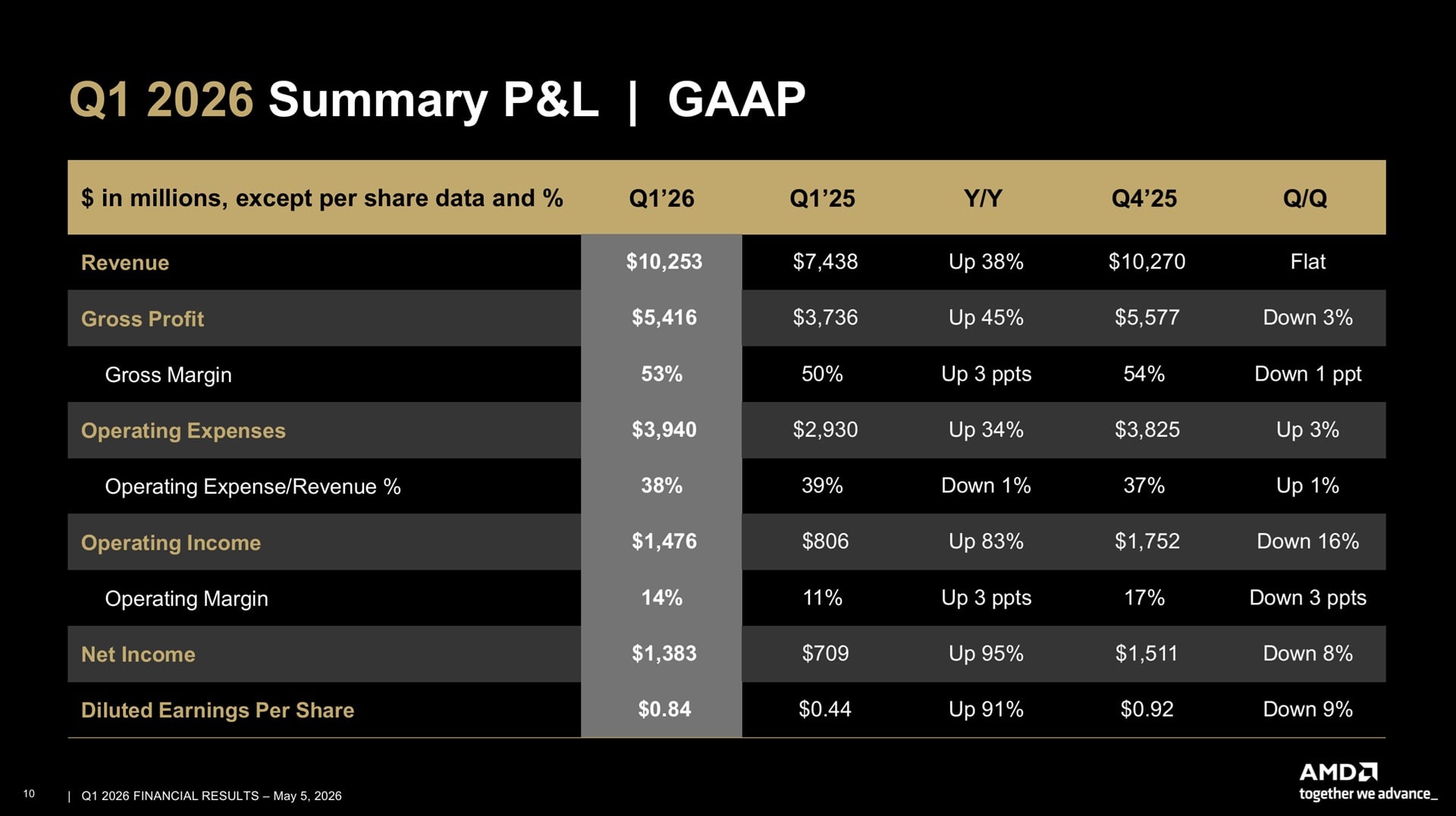
From the financial statements, AMD reported GAAP revenue of $10.3 billion, up sharply from the $7.4 billion recorded a year ago. Gross profit rose significantly as well, reaching about $5.4 billion, supported by a gross margin of 53%, an improvement from the prior year’s 50%. This margin expansion was driven by a favourable product mix, particularly the higher contribution from the Data Centre segment. On a non-GAAP basis, gross margin improved to 55%, further highlighting the strength of AMD’s high-value product lines.
Investors can see a clear trend of growth and profitability here. Operating income also saw a major jump, rising to roughly $1.5 billion, nearly doubling from the previous year. Net income followed the same trajectory, reaching about $1.38 billion, compared to $709 million in the first quarter of 2025. Diluted earnings per share came in at $0.84, reflecting a 91% year-over-year increase. These improvements were driven by both revenue growth and disciplined cost management, even as AMD continues to invest heavily in AI and next-generation compute technologies, indicative of the company’s robust market position.
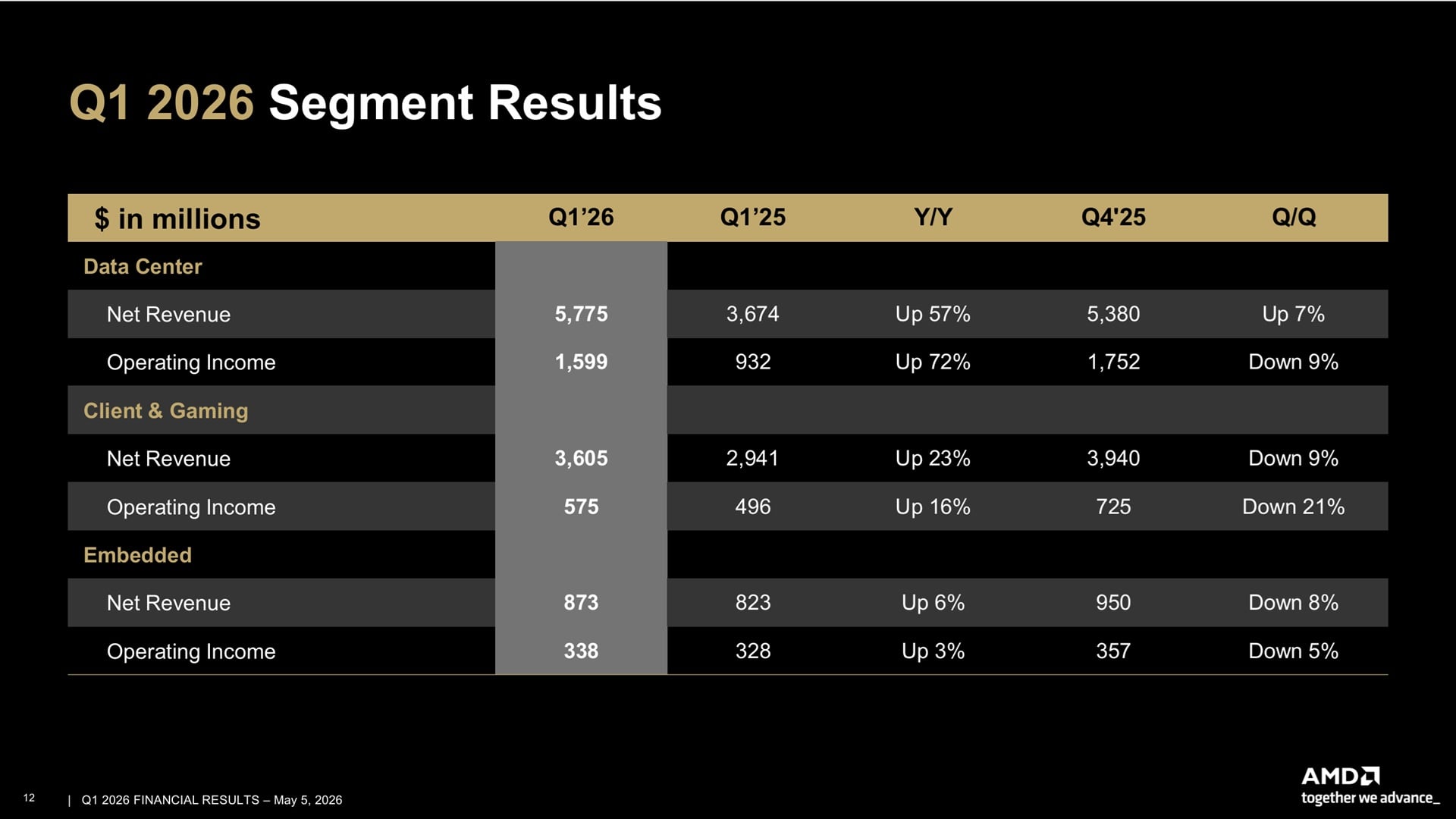
The standout performer this quarter was the Data Centre segment, which generated around $5.8 billion in revenue, up an impressive 57% year-over-year. This growth was fuelled by strong demand for AMD EPYC processors and the continued ramp-up of AMD Instinct GPUs. The segment’s operating income rose to about $1.6 billion, reflecting the high profitability of AI-optimized compute solutions. The company’s partnerships with major cloud providers, including AWS, Google Cloud, Microsoft Azure, and Tencent, continue to expand, with new 5th Gen EPYC-powered instances rolling out across multiple platforms — a testament to the demand for AMD’s solutions.
AMD’s collaboration with large hyperscale customers was another highlight, as one of the world’s biggest social platforms plans to deploy up to 6 gigawatts of AMD Instinct GPUs, beginning with a custom MI450-based solution. This represents one of the largest AI infrastructure commitments in the industry and signals strong confidence in AMD’s accelerator roadmap. The company also announced new AI-focused products such as the EPYC 8005 server CPUs and next-generation memory collaborations with leading memory manufacturers, further strengthening its position in the AI compute ecosystem and underscoring AMD’s leadership this quarter.
The Client and Gaming segment also delivered solid results, with revenue rising to about $3.6 billion, up 23% from the prior year. Client revenue alone reached roughly $2.9 billion, driven by strong demand for AMD Ryzen processors and continued market share gains in both consumer and commercial PCs. Gaming revenue grew to around $720 million, supported by Radeon GPU sales, although semi-custom revenue was slightly lower. Operating income for the segment increased to approximately $575 million, reflecting healthy demand and an improved product mix.
The Embedded segment posted revenue of about $873 million, up 6% year-over-year. Demand strengthened across several end markets, and operating income rose to roughly $338 million. AMD continues to expand its embedded portfolio with new AI-enabled processors and FPGA solutions, including the Kintex UltraScale+ Gen 2 family and Ryzen AI Embedded P100 Series. These products target industrial, imaging, networking, and edge AI applications, areas where AMD sees long-term growth potential, indicating a forward-thinking approach in product development.
Beyond the income statement, AMD’s balance sheet remains robust. Cash, cash equivalents, and short-term investments increased to about $12.3 billion, up from $10.6 billion in the previous quarter. Inventories remained stable at just over $8.0 billion, and total debt held steady at around $3.2 billion, reflecting a strong liquidity position. The company generated a record $3.0 billion in operating cash flow and $2.6 billion in free cash flow, demonstrating its ability to convert earnings into cash even while investing aggressively in future growth — a strong foundation for future investments.
From a cash deployment perspective, this level of free cash flow gives AMD significant flexibility. It can continue to fund heavy R&D spending, expand capacity with foundry partners, pursue strategic collaborations, and potentially return capital to shareholders over time. For long-term investors, strong and consistent free cash flow is often one of the clearest indicators that a company’s growth is not just theoretical but translating into tangible financial strength.
Looking ahead, AMD expects second-quarter 2026 revenue of approximately $11.2 billion, plus or minus $300 million. This outlook implies continued strong demand, particularly in AI and data center markets, and suggests that the first quarter’s momentum is not a one-off. The company also anticipates a non-GAAP gross margin of around 56%, reflecting ongoing product mix improvements and scaling of high-performance compute solutions.
For investors, AMD’s first-quarter performance reinforces the company’s strategic positioning in the AI era. With accelerating demand for high-performance CPUs, GPUs, and adaptive computing solutions, AMD is benefiting from one of the most significant technology shifts in decades. Its expanding partnerships, deepening customer engagements, and strong execution provide a solid foundation for future growth, highlighting the company’s growth trajectory.
At the same time, it is important to recognize the risks. The competitive landscape in AI and data center silicon is intense, with rivals investing heavily and racing to capture share in accelerators, CPUs, and custom silicon. AMD’s operating expenses are rising as it invests in talent, software ecosystems, and product development. While this spending is necessary to sustain leadership, it can pressure margins if revenue growth slows. These risks should be carefully monitored by investors.
As AMD represents 3% of my US stock portfolio, these results give me confidence in the company’s long-term trajectory, but they also remind me to stay disciplined. Valuations in AI-related names can swing sharply with sentiment, and even strong companies can see volatility when expectations are high. For now, though, AMD’s 1Q 2026 performance shows a business that is executing well, scaling into AI demand, and strengthening its financial foundation.
In conclusion, AMD’s 1Q 2026 results represent a pivotal moment for the company amidst industry changes.
Summary of AMD 1Q 2026 Results
Based on AMD 1Q 2026 financial results, the pros are:
- Strong year-over-year revenue and earnings growth driven by AI and data centre demand.
- Expanding partnerships with major cloud providers and hyperscalers, supporting long-term AI infrastructure deployments.
- Record free cash flow and a strengthened balance sheet provide flexibility for investment and potential capital returns.
- Continued market share gains in Client and Gaming segments with competitive Ryzen and Radeon product lines.
- Robust product roadmap across CPUs, GPUs, FPGAs, and embedded solutions targeting multiple high-growth markets.
The cons are:
- Operating expenses continue to rise as AMD invests heavily in AI, software, and R&D.
- Intense competition from NVIDIA, Intel, and emerging AI chipmakers could pressure margins and market share.
- Semi-custom revenue softness and cyclical demand in gaming can introduce earnings volatility.
- Dependence on third-party manufacturing and supply chain stability remains a structural risk for execution.