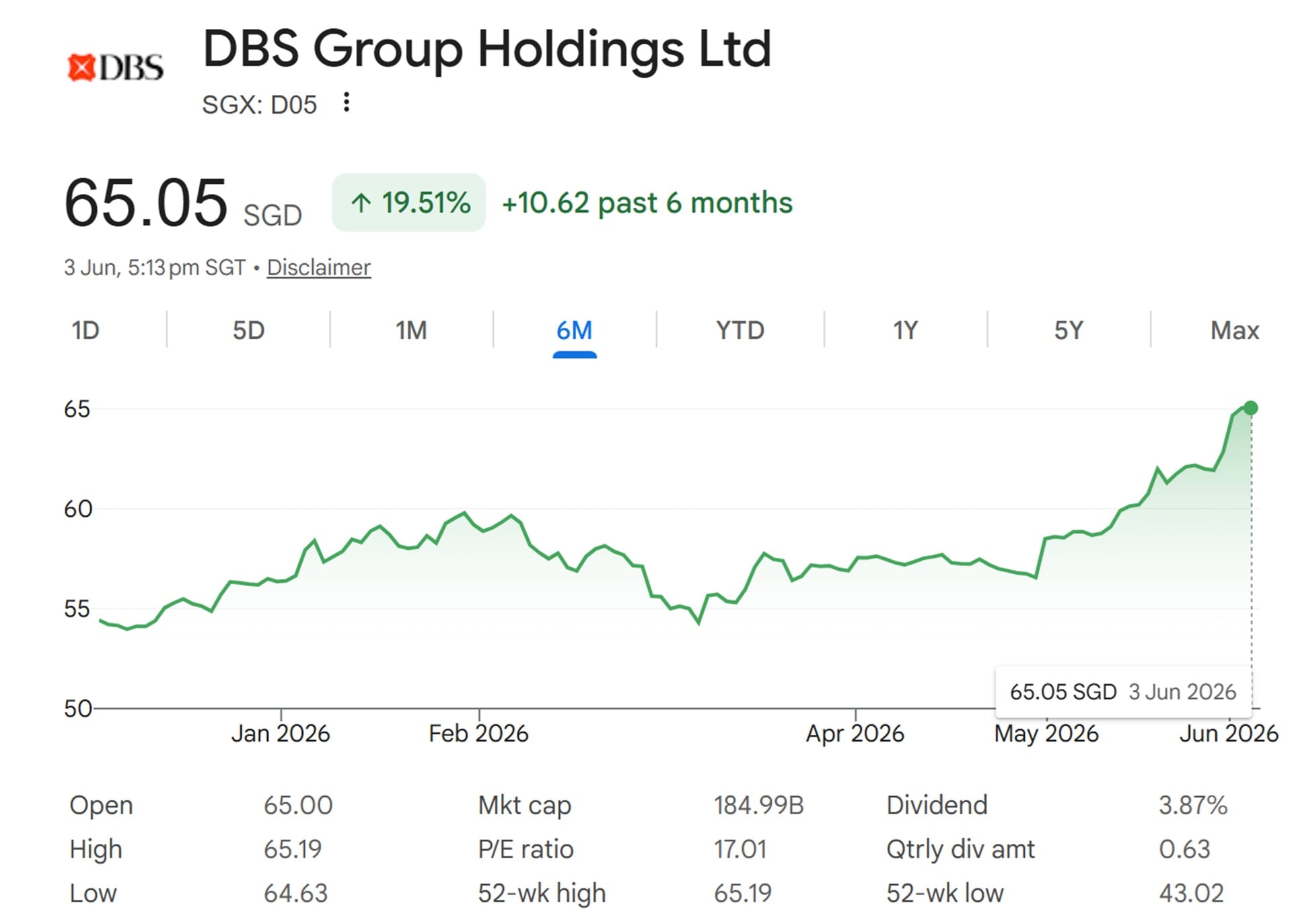
The DBS share price reached a new record high of S$65.19 on 3 June 2026, marking yet another milestone for Singapore’s largest bank. This rally underscores the market’s growing confidence in DBS Group Holdings following its robust 1Q 2026 financial results, which reaffirmed the bank’s leadership in profitability, capital strength, and digital innovation.
The surge in the DBS share price reflects not only strong quarterly earnings but also investors’ belief that DBS is well positioned to sustain growth amid a challenging global environment. As regional peers continue to navigate slower loan growth and margin compression, DBS has demonstrated resilience through diversified income streams and disciplined cost management.
The DBS share price also signals how investors are rewarding banks that combine strong fundamentals with clear strategic direction. With DBS continuing to execute on its digital and regional growth strategies, the market is increasingly viewing the bank as a long-term compounder rather than just a cyclical financial stock.
Record-Breaking Momentum in DBS Share Price
The DBS share price has been on a steady upward trajectory since the release of its 1Q 2026 results in late April. From around S$60 in mid-May, the stock climbed rapidly, crossing S$63 by the end of May and finally touching S$65.19 today. This represents a gain of roughly 8 percent in just three weeks, a remarkable performance for a blue-chip counter in Singapore’s banking sector.
Market analysts attribute the rally in the DBS share price to sustained institutional buying and renewed optimism about DBS’s earnings outlook. The bank’s ability to deliver record profits despite global interest-rate volatility has reinforced its reputation as a defensive yet growth-oriented play. For many investors, DBS has become a core holding that offers both stability and upside potential.
The DBS share price has also benefited from positive sentiment surrounding Singapore’s financial sector, where liquidity remains strong and credit quality stable. With dividend yields still attractive relative to regional peers, DBS continues to draw both income-focused and long-term investors who see the bank as a reliable anchor in their portfolios.
Highlights of DBS 1Q 2026 Financial Results
DBS reported a net profit of S$2.93 billion for the first quarter of 2026, up 12 percent year on year. Total income rose to about S$5.5 billion, driven by higher net interest income and resilient fee income across wealth management, cards, and transaction services. These strong numbers form the fundamental backdrop supporting the current level of the DBS share price.
The bank’s return on equity (ROE) stood at an impressive 17 percent, maintaining its position as one of the most profitable banks in Asia. Net interest margin (NIM) remained healthy at around 1.88 percent, supported by disciplined deposit pricing and strong loan yields. This combination of high ROE and solid NIM is a key reason why the DBS share price commands a valuation premium over regional peers.
Asset quality remained robust, with the non-performing loan (NPL) ratio holding steady at about 1.0 percent. DBS’s Common Equity Tier 1 (CET1) capital ratio of roughly 15.2 percent provides ample buffer for growth, regulatory requirements, and shareholder returns. These metrics reassure investors that the bank is not stretching its balance sheet to chase growth, which in turn supports confidence in the sustainability of the current DBS share price.
Digital Leadership and Structural Advantages
Beyond the headline financials, DBS’s digital transformation remains a key driver of its valuation. The bank’s investments in AI-powered risk analytics, digital onboarding, and ecosystem partnerships have deepened customer engagement while lowering cost-to-income ratios. This digital edge is increasingly reflected in the DBS share price, as investors reward banks that can scale efficiently.
Digital transactions now account for a large majority of customer interactions, and digital revenue contributes a significant share of group income. This structural advantage allows DBS to maintain profitability even as traditional banking margins tighten. The scalability of its digital platforms means that incremental revenue often comes with relatively lower incremental costs, enhancing operating leverage and supporting the upward trend in the DBS share price.
Investors recognize that such digital leadership translates into sustainable earnings growth. As a result, the DBS share price has outperformed regional peers in 2026, reflecting the market’s view that DBS is better positioned for the future of banking than many of its competitors.
Investor Confidence Strengthened by Consistent Dividends
DBS’s commitment to shareholder returns continues to underpin confidence in the DBS share price. The bank declared a quarterly dividend of S$0.54 per share, maintaining its payout ratio while preserving capital flexibility for future expansion and potential acquisitions. For many investors, this balance between growth and income is highly attractive.
With the stock now trading above S$65, the forward dividend yield remains competitive for a high-quality financial institution. Income-focused investors see DBS as a reliable dividend payer, while growth-oriented investors are drawn to its earnings momentum and strategic initiatives. This dual appeal has helped support the DBS share price at elevated levels.
By consistently rewarding shareholders through dividends while still investing in technology and regional expansion, DBS has built a strong track record of capital allocation. This track record is a key reason why the market is comfortable assigning a premium valuation to the bank, and why the DBS share price continues to set new highs.
Market Reaction and Analyst Commentary
Analysts have largely maintained bullish calls on DBS following its 1Q 2026 results. Several brokerages have raised their target prices into the S$66 to S$68 range, citing strong earnings visibility, robust capital ratios, and continued digital leadership. This positive research coverage has reinforced sentiment and provided further support for the DBS share price.
Commentary from analysts often highlights DBS’s ability to generate high returns on equity while maintaining conservative risk management. Many note that the bank’s diversified income streams, spanning net interest income, fees, and trading, provide resilience against macroeconomic headwinds. This resilience is a key factor behind the strength of the DBS share price in 2026.
Trading volumes in DBS have also increased, suggesting broad participation from both institutional and retail investors. The combination of strong fundamentals, positive analyst views, and healthy liquidity has created a virtuous cycle that continues to support the DBS share price.
Comparative Strength Against Peers
While OCBC and UOB also reported solid 1Q 2026 results, DBS’s superior profitability and efficiency metrics continue to set it apart. Its ROE of around 17 percent compares favourably with OCBC’s roughly 13 percent and UOB’s approximately 11.5 percent. This performance gap is reflected in the higher level of the DBS share price relative to its peers.
The DBS share price has effectively become a benchmark for Singapore’s banking sector. Investors often look at DBS as a bellwether for regional financial health. When DBS performs well and its share price rises, it tends to lift sentiment across the broader market, reinforcing its status as a core holding in many portfolios.
DBS’s diversified geographic footprint, with meaningful operations in Singapore, Hong Kong, and other key Asian markets, provides additional resilience. This regional diversification helps smooth earnings across different economic cycles and supports the stability of the DBS share price over time.
Macroeconomic Context and Interest-Rate Outlook
The global interest-rate environment remains uncertain, but DBS has shown that it can navigate different rate cycles effectively. Its treasury operations and asset-liability management strategies have allowed it to capture margin opportunities while mitigating rate risks. This capability is one reason why the DBS share price has remained strong even amid shifting macro conditions.
As central banks signal a gradual normalization of rates, DBS’s strong deposit franchise positions it to maintain healthy spreads. Even if net interest margins ease slightly, investors expect fee income and trading gains to help offset the impact. This adaptability is a key reason the DBS share price continues to climb.
Markets tend to reward banks that can deliver consistent returns regardless of macro volatility. DBS’s track record of managing through different economic environments has given investors’ confidence that the current level of the DBS share price is supported by underlying fundamentals rather than short-term speculation.
Strategic Growth Initiatives
DBS continues to pursue strategic growth initiatives that enhance its long-term earnings potential. The integration of Citi’s consumer banking business in Taiwan, for example, has begun contributing positively to earnings and expanding DBS’s regional footprint. These moves support the long-term trajectory of the DBS share price by opening new avenues for growth.
The bank is also investing heavily in sustainability-linked financing and green bonds, aligning with global trends toward ESG-focused investing. By positioning itself as a leader in sustainable finance, DBS is attracting a broader base of institutional investors, which in turn supports demand for its shares and underpins the DBS share price.
Such forward-looking strategies reinforce the narrative that DBS is not merely riding cyclical tailwinds but actively shaping its long-term growth trajectory. This strategic clarity is another factor fuelling investor confidence and supporting the current level of the DBS share price.
Technical View: Momentum and Valuation
From a technical perspective, the DBS share price shows strong upward momentum. The stock has broken past previous resistance levels around S$63 and S$64, with trading volume confirming the breakout. Technical indicators such as moving averages and relative strength suggest that the trend remains positive.
At S$65.19, DBS trades at a premium to book value, but many investors view this premium as justified given its high ROE, strong capital position, and consistent dividend policy. The market appears comfortable paying up for quality, and this willingness to assign a higher multiple is clearly reflected in the DBS share price.
While valuations are not cheap compared to some regional peers, the combination of earnings growth, dividend income, and balance-sheet strength makes DBS an attractive proposition for long-term investors. As long as the bank continues to deliver on its strategic and financial targets, the DBS share price is likely to remain well supported.
Outlook for the Rest of 2026
Looking ahead, DBS is expected to maintain its earnings momentum through the remainder of 2026. Loan growth in Singapore and Hong Kong should remain steady, while fee income from wealth management, cards, and transaction services continues to expand. These trends provide a solid foundation for the DBS share price going forward.
Digital initiatives will further enhance efficiency, and treasury operations may benefit from favourable rate movements. Analysts forecast that full-year 2026 net profit could exceed S$11 billion if current trends persist. Such an outcome would likely provide further support for the DBS share price and could even open the door to additional dividend increases or capital management initiatives.
For now, the new high of S$65.19 on 3 June 2026 stands as a clear reflection of investor confidence in DBS. With strong 1Q 2026 financial results, a proven digital strategy, and a disciplined approach to growth, the DBS share price appears to be anchored by solid fundamentals rather than fleeting market sentiment.