Table of Contents
Mapletree Logistics Trust 2Q FY26/27 financial results demonstrate the resilience of one of Singapore’s largest logistics REITs despite a challenging macroeconomic environment characterised by elevated interest rates, currency volatility and slowing global growth.
As a unitholder, I continue to monitor Mapletree Logistics Trust closely as it currently makes up 3.47% of my stock portfolio.
Mapletree Logistics Trust closed at S$1.10 on 30 October 2026. The latest Mapletree Logistics Trust 2Q FY26/27 financial results suggest management is making steady progress in strengthening the portfolio through capital recycling, redevelopment initiatives and prudent balance sheet management.
Although the REIT sector continues to face headwinds from elevated financing costs, Mapletree Logistics Trust has maintained stable distributions while improving its portfolio quality and preserving financial flexibility.
Key Highlights From The Mapletree Logistics Trust 2Q FY26/27 Financial Results
The headline figures from the Mapletree Logistics Trust 2Q FY26/27 financial results were broadly stable.
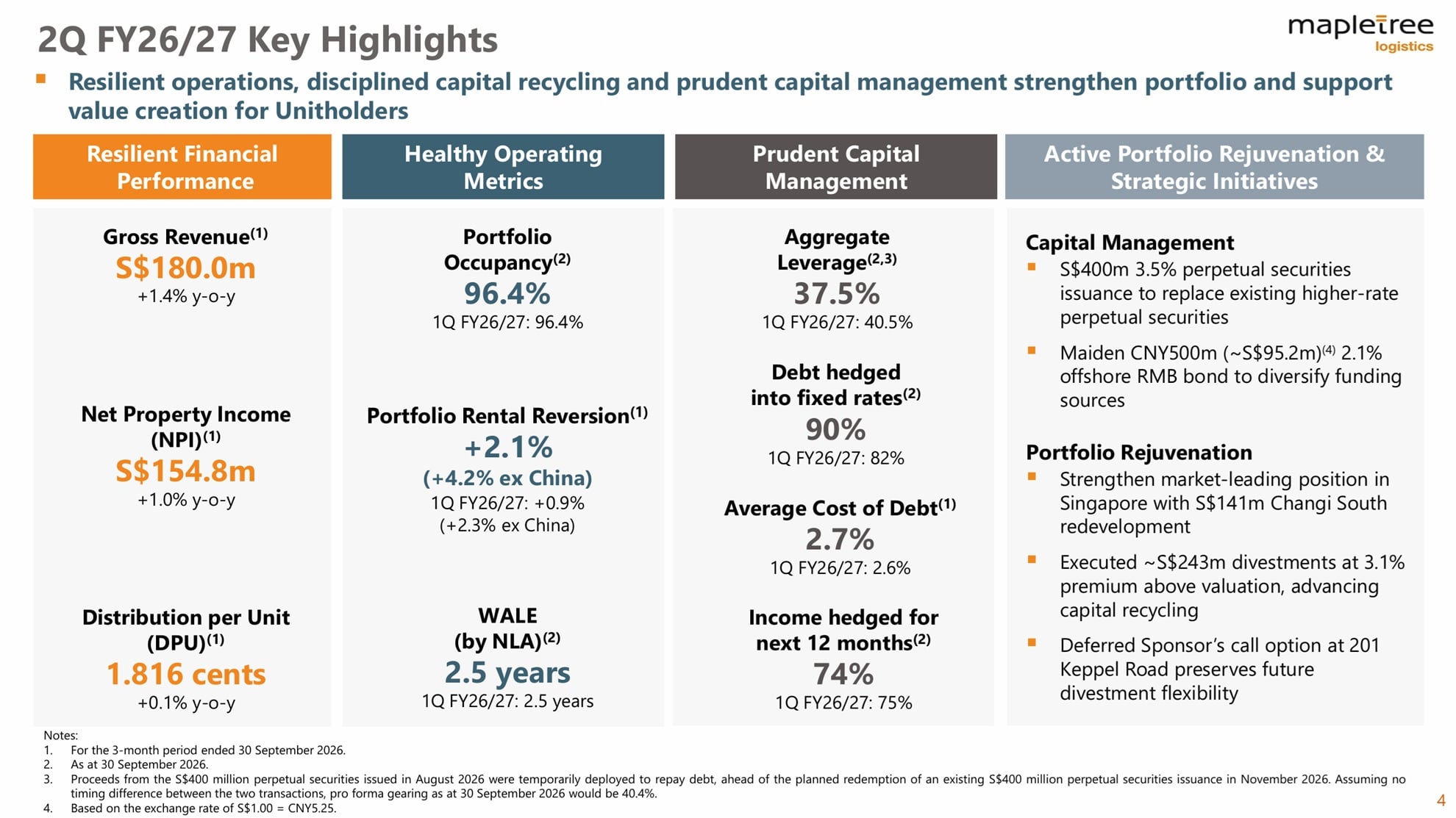
Gross revenue increased 1.4% year-on-year to S$180.0 million. Net property income rose 1.0% to S$154.8 million while distributable income to unitholders increased 0.9% to S$93.3 million.
Most importantly for income investors, distribution per unit remained stable at 1.816 Singapore cents, representing a slight increase of 0.1% compared to the same period last year.
For the first half of FY26/27, gross revenue rose 1.1% to S$358.9 million while net property income increased 1.5% to S$311.2 million. Amount distributable to unitholders grew 1.0% to S$186.3 million while DPU improved marginally to 3.632 Singapore cents.
While the growth rates may appear modest, maintaining stable distributions in a difficult operating environment is a notable achievement.
Healthy Occupancy Supports Stable Earnings
One of the most encouraging aspects of the Mapletree Logistics Trust 2Q FY26/27 financial results is the continued strength of the operating portfolio.
Portfolio occupancy remained high at 96.4%, while the weighted average lease expiry stayed stable at 2.5 years.
Occupancy improved in several key markets including China, South Korea and Hong Kong. China occupancy rose to 94.4%, while South Korea achieved an impressive 98.4% occupancy.
These improvements helped offset softer occupancy levels recorded in Japan and India.
High occupancy levels continue to provide visibility for future rental income and support the trust’s ability to maintain distributions.
Rental Reversions Continue To Improve
Another positive takeaway from the Mapletree Logistics Trust 2Q FY26/27 financial results was the improvement in portfolio rental reversions.
Portfolio rental reversion improved to 2.1% from 0.9% in the previous quarter. Excluding China, rental reversion reached 4.2%, highlighting stronger rental growth across the rest of the portfolio.
Singapore delivered a healthy rental reversion of 5.3%, reflecting strong demand for quality logistics space and limited new supply. South Korea recorded 6.3%, while Vietnam posted 5.3%. India also achieved positive rental reversion of 3.3%.
China remained the weakest market with rental reversion of negative 1.7%, although conditions appear to be stabilising gradually compared to previous periods.
The improvement in overall rental reversions suggests that leasing demand remains resilient despite economic uncertainties.
Diversification Remains A Key Strength
The Mapletree Logistics Trust 2Q FY26/27 financial results continue to showcase one of the REIT’s biggest strengths, which is geographic diversification.
As at 30 September 2026, the trust owned 172 logistics properties across nine countries with assets under management of S$13.1 billion.
The portfolio spans Singapore, China, Hong Kong, Japan, South Korea, Australia, Malaysia, Vietnam and India.
This diversification helps reduce reliance on any single market while providing exposure to different growth opportunities across Asia-Pacific.
The tenant base is also highly diversified with 985 tenants. The top ten tenants contribute only about 19.9% of total gross revenue, reducing concentration risk.
Approximately 85% of revenue is derived from tenants serving domestic consumption, which helps shield the portfolio from global trade volatility.
Portfolio Rejuvenation Continues To Progress
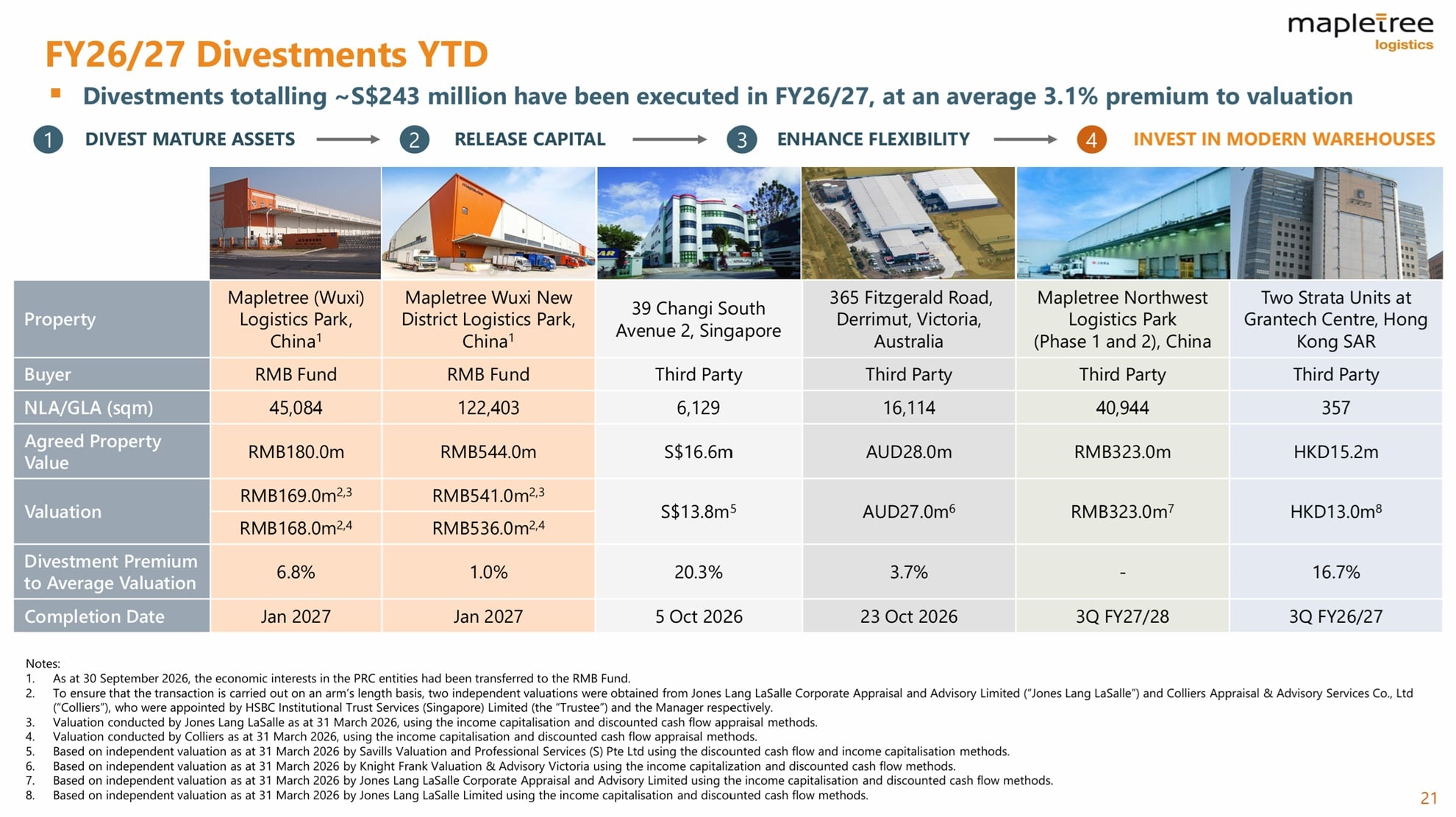
A major highlight within the Mapletree Logistics Trust 2Q FY26/27 financial results is the continued focus on portfolio rejuvenation.
During FY26/27 year-to-date, management executed approximately S$243 million of divestments at an average premium of 3.1% above valuation.
The divestments involved properties located across China, Hong Kong, Australia and Singapore.
Management’s objective is not simply to sell assets but to recycle capital into newer and more productive logistics facilities with stronger long-term growth potential.
This strategy should help improve the quality of the portfolio and support future rental growth.
Changi South Redevelopment Strengthens Long-Term Growth
One of the most significant growth initiatives announced during the quarter is the redevelopment of 9 and 15 Changi South Street 2.
The project will transform two older assets into a modern five-storey Grade A ramp-up logistics facility in eastern Singapore.
Gross floor area is expected to increase by 34% to nearly 500,000 square feet.
The estimated development cost is approximately S$141 million, with completion targeted for 2Q 2029.
Singapore remains Mapletree Logistics Trust’s largest and most important market, contributing more than 30% of gross revenue. The redevelopment reinforces management’s commitment to strengthening its position in this core market.
The development should also benefit from strong connectivity to Changi Airport and major transportation networks.
Balance Sheet Strength Continues To Improve
Many REIT investors remain concerned about the impact of high interest rates on distributions. Fortunately, the Mapletree Logistics Trust 2Q FY26/27 financial results indicate that management continues to actively manage balance sheet risks.
Aggregate leverage declined from 40.5% to 37.5% during the quarter.
Total debt fell from S$5.5 billion to S$5.1 billion while net asset value per unit increased from S$1.26 to S$1.27.
The reduction in leverage was supported by the issuance of S$400 million of perpetual securities, which were temporarily used to repay bank borrowings ahead of a planned redemption.
The trust also maintains available committed credit facilities of approximately S$1.15 billion, providing significant refinancing flexibility.
Active Capital Management Reduces Financing Risks
The Mapletree Logistics Trust 2Q FY26/27 financial results also highlighted proactive capital management initiatives.
During the quarter, management issued its maiden CNY500 million offshore Renminbi bond at a competitive coupon rate of 2.1%.
This diversifies the trust’s funding sources while helping to optimise borrowing costs.
The trust also issued S$400 million of lower-rate perpetual securities to replace an older and more expensive issuance.
These financing initiatives demonstrate management’s commitment to improving funding efficiency and maintaining access to multiple capital markets.
Interest Rate Risk Appears Well Managed
Perhaps one of the most reassuring aspects of the Mapletree Logistics Trust 2Q FY26/27 financial results is its interest rate management strategy.
Approximately 90% of total debt has been hedged into fixed rates.
In addition, around 74% of distributable income expected over the next twelve months has been hedged into Singapore dollars.
This strategy helps minimise the impact of both higher interest rates and foreign currency fluctuations on distributable income.
Management estimates that a 25-basis-point increase in interest rates would reduce distributable income by only about S$0.3 million per quarter, which translates into approximately 0.01 Singapore cents of DPU.
Such sensitivity appears manageable given the size of the portfolio.
Outlook For Mapletree Logistics Trust
Despite the resilient results, management remains cautious about the external environment.
Ongoing geopolitical tensions, elevated energy prices, inflationary pressures and currency volatility continue to create uncertainty.
Interest rates may remain higher for longer while economic growth could moderate across several major economies.
These factors may affect both tenant demand and financing costs going forward.
Nevertheless, leasing demand across the portfolio remains broadly stable. Developed markets contribute more than 70% of the portfolio’s value and revenue, providing an important source of earnings stability.
The large exposure to domestic consumption-related tenants also enhances resilience during periods of economic volatility.
My Thoughts On The Mapletree Logistics Trust 2Q FY26/27 Financial Results
Overall, I view the Mapletree Logistics Trust 2Q FY26/27 financial results positively.
The trust continues to demonstrate resilience despite operating in a difficult environment. Occupancy remains high, rental reversions are positive, leverage has improved and management continues to execute its portfolio rejuvenation strategy.
While this may not be a high-growth REIT in the near term, it offers something that many income investors value greatly: stability.
The strategic divestments, redevelopment projects and proactive capital management initiatives should help position the trust for sustainable long-term growth.
With Mapletree Logistics Trust accounting for 3.47% of my stock portfolio, I remain comfortable holding my position.
At a closing price of S$1.10 on 30 October 2026, the latest Mapletree Logistics Trust 2Q FY26/27 financial results suggest that management is successfully navigating current challenges while building a stronger logistics platform for the future.